AI Products & Strategy
A Point Release That Draws in 3D: Two Days With Claude Fable 5.2
Claude Fable 5.2 arrived as a point release with a price cut. I used it to redesign this site, with a 3D map of every article, live two days after launch, and to review an app across four repositories. What Anthropic claimed, what held, where the cheaper Opus 5.5 did the work, and what I will test when the next Fable ships.
The moment I stopped thinking of Claude Fable 5.2 as a point release was on the Atlas page of this site. Every piece I have published showed up as one connected graph. I could drag it and look at it from any angle, and when I clicked a point, it lit up the articles that piece connects to. The model that built it had shipped that same week.
I had not expected much. Fable 5.1 shipped on 1 September 2026 and Fable 5.2 followed on 9 November (Anthropic). The launch coverage I read led with the price: $8 per million input tokens and $40 per million output, down from $10 and $50, with output up to 30% faster (Anthropic; coverage from Lindy and Tech Times). The four or five reviews of Fable 5.1 I had watched praised its UI work and showed nothing in 3D. My own use matched: on another project, 5.1 gave me a UI overhaul with a day-and-night difference, after a UI pattern library, an AI design tool and my own UI skill had all left me unsatisfied. But I never asked 5.1 for 3D. When the same reviewers spent their 5.2 videos on 3D scenes, games and animation, I decided to test it on something I own.
This review covers two projects. The first is the redesign of this site, live two days after the model shipped. The second is a UX review of an app I am building, which spans four repositories. The short version: Anthropic’s new claim for 3D and motion held up on a real site, and it showed up in a place I did not expect, in how Fable explained its proposals to me. Fable alone did not finish either job, and the split that did finish them is the part worth copying.
I sent the live site to ten or twelve people in my close circle. “Magical” and “next level” were the words that came back. They are friends, so I count that as encouragement, not evidence. The evidence follows.
What Anthropic Shipped, and What It Claimed
Anthropic’s own numbers show a large step for a point release (Anthropic):
| Benchmark (Anthropic’s evaluations, highest available effort) | Fable 5.1 | Fable 5.2 | Opus 5.5 |
|---|---|---|---|
| FrontierCode 2.0, agentic coding | 32.4% | 49.1% | 45.5% |
| FrontierSWE v2 | 56.3% | 69.9% | 62.3% |
| RoboDojo Sim, robotics | 27.6% | 64.9% | 39.4% |
The more telling change is in what Anthropic says the model is for. The Fable page now has a section called “Design for 3D, hardware, and motion”, which says Fable 5.2 builds interactive 3D worlds and creates simulations and animations in code. The same page says it takes on loosely defined problems across multiple repositories with “strong architectural judgment” (Anthropic). The Fable 5.1 launch post had no section on 3D, motion or visual design at all; it led with coding and knowledge work, with scientific research close behind (Anthropic).
So the surprise I felt is consistent with the record: neither the 5.1 launch post nor the Fable page as it stood in October (archived copy) mentioned 3D or motion, and the 5.2 page has a whole section for it. What I cannot claim is that 5.1 would have failed at it. I never tried.
KEY INSIGHT: a point release can change what a model is for, not only what it costs. The price table tells you whether to switch; the capability sections tell you what to try. For Fable 5.2, the new section mattered more to me than the price.
Test 1: From Release to a Live Site in Two Days
On 10 November, the day after the release, I gave Fable 5.2 a brief: a new and very different look for this site, with real 3D, that loads fast on a phone, a tablet and a computer and never slows the articles, because this is a reading site first. I asked for live mocks built from the site’s real posts. Fable built three at its xhigh effort setting, on its own, with no helper agents: a 3D graph of every piece, a drafting set of particle drawings, and a lit bookshelf.
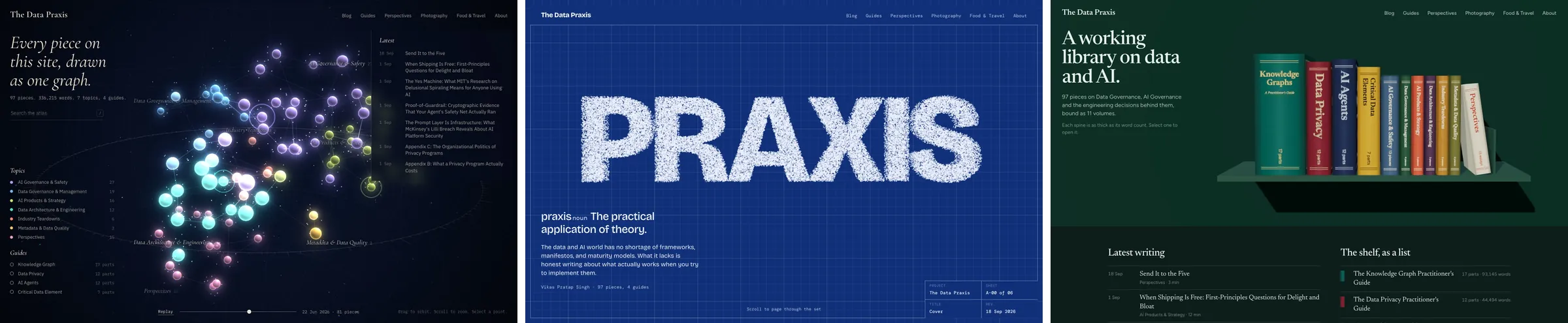
I picked the drafting set for the homepage and the graph as a second page, the Atlas. The decisions were locked in rounds on a private web form, with a picture for each choice, and an exit contract listed the checks that would tell me the work was done. I describe this way of starting work on How I Write. The speed rule was mine, from the brief. The numbers were Fable’s: the decision form proposed eight targets, based on what its own mocks had measured, and I locked them in the first round, before any production code. Among them: the opening text within one second on a slowed phone, no 3D work until the text is on screen, the first drawing within 2.5 seconds, no stall longer than 50 milliseconds, a smooth frame rate on phones, and articles as fast as before, with at most 5 KB more styles. A separate decision said the motion must come to rest within five seconds of the last scroll.
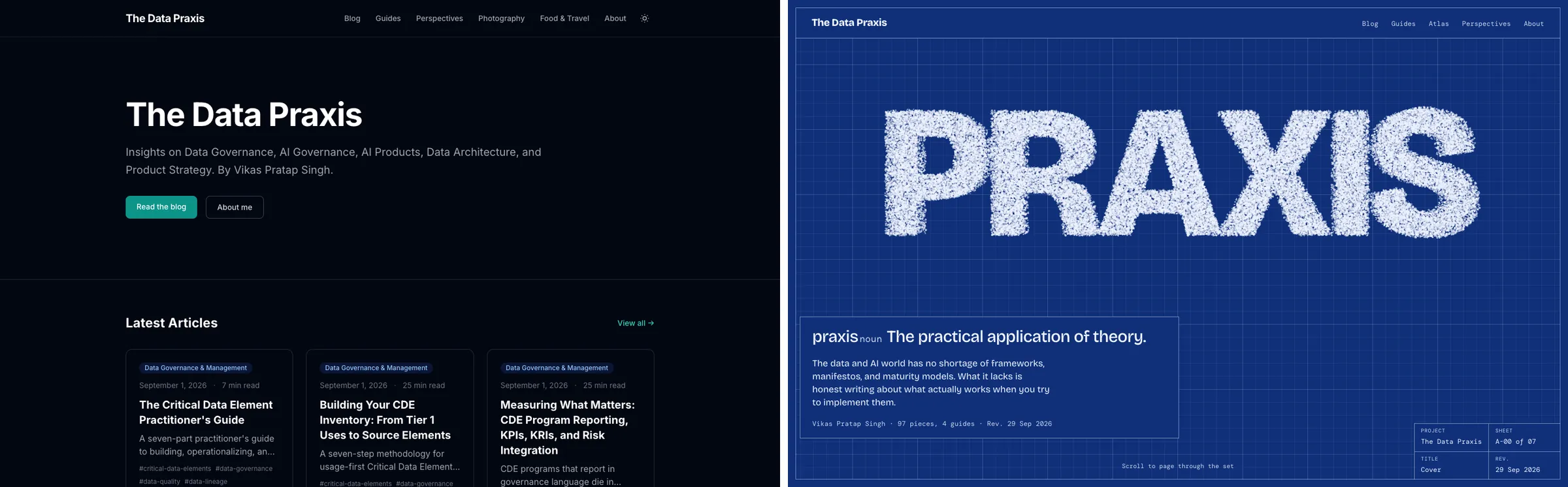
The homepage. The drawing is hand-written WebGL2 with no 3D library. One cloud of points, like ink dust, re-forms into a different drawing for each sheet as you scroll: the site’s name, a graph for the Knowledge Graph guide, a grid for the Critical Data Element guide, a shield, an agent loop. The points drift on a slow flow, and a mouse pointer pushes the nearest ones aside. That was the detail I liked most: the way the dust flows around the cursor, over the drawings, felt right to me. On a touch screen the drawings form without the cursor effect.
The Atlas. Every published piece is a point, coloured by its group. The lines are computed when the site is built, and there are three kinds: reading order inside a guide (48 lines), links I wrote from one article to another (411), and shared tags, where two pieces share at least two tags (52). The 3D library runs on that page only, inside a background worker, and a plain list of every piece shows first and stays as the fallback.
What was measured. A separate verifier ran five first visits on a phone-sized window with the processor slowed four times and a slow 4G connection:
| Target | Measured |
|---|---|
| Opening text within 1.0 s | 848 to 885 ms |
| First drawing within 2.5 s | 2.33 to 2.35 s |
| No stall over 50 ms after the text | none in any visit |
| Drawing code, compressed | 9.9 KB |
| Articles as fast as before | same script count; styles 2.3 KB larger, under the 5 KB allowed |
| 30 frames a second on my phone, 60 on my laptop | not yet checked on my own devices at release |
The release went out on the evening of 11 November, two days after the model shipped.
One outside test shows why the budget mattered. A tester gave both models the same prompt for each of three builds. Fable’s racing game and landing page looked better, but in the black hole simulation the screenshots showed 1 to 4 frames a second for Fable against 31 to 41 for Opus (AI Fire). The capability to draw is not the same as the discipline to draw cheaply. On my site, Fable showed that discipline: its own mocks already beat the numbers it proposed, and the contract held the build to them. If a device cannot hold 20 frames a second for three seconds, the code drops the drawing to plain text.
For practitioners: put the speed rule in the brief, and lock the frame and size numbers before any production 3D code. A number like “first drawing within 2.5 seconds on a slowed phone” gives the model something to build toward and gives the verifier something to fail.
Where Fable Stopped and Opus Took Over
The commit log for 11 November tells a less heroic story than the clips. 27 commits carry a Fable 5.2 credit and 54 carry an Opus 5.5 credit. Fable made the mocks, ran the decision rounds, wrote the homepage drawing, the Atlas and the diagram kit. Opus 5.5 restyled the article pages and redrew and recoloured all 50 diagrams in the Knowledge Graph guide.
The diagram batch is a fair picture of the split. Fifteen Opus workers at medium effort did the colouring, and Opus reviewers at high effort raised 25 points, none rated high; 22 of the 25 needed a fix from the workers. Medium effort was enough for volume work against a clear packet, provided someone checked it.
Then Fable ran out. In the middle of the fourth verification round, the session hit the Fable usage limit, and rounds four to seven finished on Opus, marked in my records as a fallback. I am not alone in this. One comparison of the two models opens with the same experience: a long Fable run ends with a look at the usage screen, because “Fable models eat into plan limits faster” (Lindy).
The verification itself taught me the most. Each round had a full verifier and a second, independent lens. In rounds four, five and seven, the second lens found a real fault the full verifier had passed: a background script downloaded twice, a caption sitting over text, two diagram faults, a tap that did not close the zoom view. In round six, two Opus agents stopped at the weekly limit with nothing written. The rule was that a round passes only when both agree, and that rule caught all of them before release. The final verdict came from a fresh Fable verifier: no failures, and one new medium issue that is still open.

This is close to what Anthropic recommends. Its launch post calls Opus 5.5 Anthropic’s “strongest daily driver”, says most coding and knowledge tasks should start there and switch upward to Fable as required, and lists “Orchestrator”, where Fable delegates simpler tasks to smaller models, among Fable’s roles (Anthropic). The list prices agree: Opus 5.5 lists at $4 and $20 per million tokens, half of Fable 5.2 (Claude pricing). Anthropic also reports that on FrontierCode 2.0, in early testing, Fable 5.2 “at High effort scored about level with Opus 5.5 at Max effort, for roughly half the cost per task” (Anthropic). That is an argument for using Fable on the hard part, not for using it on everything.
Test 2: Finding Where an App Goes Cold, Across Four Repositories
The second project is an app I am building, and I will keep it unnamed. I asked Fable 5.2 a question that is easy to say and hard to answer: where does the experience lose its warmth and leave the user in bare territory? I asked it to look through about twenty lenses, among them behavioural science, user psychology, a neuroscience lens (what the brain is likely doing at that moment), and the design principles of a good mobile app.
The answers did not live in one repository. The app has a front end, two back ends and a repository for its AI features, and Fable worked across all four. That makes sense: a screen can feel cold because of what a back end returned, how long it took, or what an AI feature said, so a review of the screens alone can miss the cause. I was pleased with the outcome, and Fable then split the work into pieces that Opus 5.5 could carry out at medium effort, the same split as the redesign.
The difference I did not expect was in the decision form. When I sat down to lock decisions, every proposal that involved motion was shown in motion: a flow drawn as a short animation, where a tap on one screen leads to the next. It made it far easier to see what Fable was proposing, before any code changed. The capability Anthropic claims for 3D and motion also helped me read a design, not only build one. Anthropic’s launch post says testers found that 5.2 communicates more clearly than past Fable models (Anthropic); this is what that looked like for me.
What Did Not Go Well
A review that only lists the wins is an advertisement, so here is the rest:
- The usage limits were not in the plan. Fable stopped mid-verification with no handoff note written, and one would have made the switch to Opus easier. Opus then hit its weekly limit in round six, and two of its agents stopped with nothing written.
- The mocks had no independent reviewer. Fable checked them with its own screenshots. A layout collision on a short laptop screen showed up only after they were published for me to view, and one coding error cost a rebuild.
- One defect is still open. In the zoom view for the redrawn diagrams, pinching or scrolling to zoom slides the drawing sideways.
- Some devices are untested. The release was checked in Chrome and Safari and on my own phone, but not in Firefox, Samsung Internet or on a real tablet.
- I did not total the cost. The Opus diagram batch alone used 2.86 million tokens. I never added up the Fable sessions, so I cannot tell you what the redesign cost.
None of these changes my verdict, but each is something I will plan for next time.
What I Will Test When the Next Fable Ships
Anthropic has announced neither a Fable 5.5 nor a Fable 6; its Fable page lists announcements up to 5.2 (Anthropic). “Fable 5.5” circulated as a rumoured name in October, and the release that came next was numbered 5.2 (GPTProto). What the record does show is a pattern. Fable 5 shipped on 9 June 2026, 5.1 about twelve weeks later, and 5.2 about ten weeks after that (Anthropic). Prices came down at each step: cache reads at 5.1, then the whole price list at 5.2. The 5.1 post showcased scientific research; the 5.2 page adds 3D, hardware, motion and robotics.
My expectation, and it is only that: if the cadence holds, the next Fable arrives around late January 2027, and the line to watch is the one between the model that designs and the model that builds. If the next release closes it, the whole two days in this article would run on one model inside one plan’s limits. If it opens a new front instead, the robotics number, up from 27.6% to 64.9% in one release, suggests where Anthropic is pushing: from things that move on a screen to things that move in a room.
I will not guess more than that. Here are the tests I will run on the first day instead:
- The same brief, the same contract. The eight speed targets are now a personal benchmark. Does the next model meet them without an Opus builder for the volume work?
- The open zoom bug. A small, real defect that no model has seen.
- The four-repository review, asked from scratch. Compare its findings with the 5.2 findings.
- Cost per finished release. This time, with the tokens counted from the start.
Do Next
| Priority | Action | Why it matters |
|---|---|---|
| Not started yet | Give Fable 5.2 one visual brief on something you own, with a speed rule in the brief and the numbers locked before production code | 3D and motion is the capability the 5.2 Fable page adds, and the locked numbers held my site to its load targets |
| Not started yet | Ask the model to show its proposals as animated flows before it builds | Seeing a flow move made the four-repository proposal clear before any code changed |
| Adopting at work | Let Fable design and split the work; build the pieces on Opus 5.5 at medium effort | Opus costs half as much per token, and Anthropic names orchestrator as a role Fable can play |
| Adopting at work | Add a second, independent verifier lens before every release | In three Opus rounds it found a real fault that the main verifier had passed |
| Preparing for what comes next | Keep your exit contract as a benchmark for the next model | The same targets give a fair before and after when the next Fable arrives |
| Preparing for what comes next | Write a handoff before any long Fable run | My Fable session stopped mid-verification without one |
The launch coverage said cheaper and faster. What I got was a model that showed me its designs in motion and then built the hard parts. The rest took a cheaper model, a contract I signed first, and verifiers who did not write the work.
Sources & References
- Introducing Claude Fable 5.2 and Claude Mythos 5.2 (Anthropic)(2026)
- Claude Fable product page (Anthropic)(2026)
- Claude Fable product page, archived 20 October 2026 (Internet Archive)(2026)
- Introducing Claude Fable 5.1 and Claude Mythos 5.1 (Anthropic)(2026)
- Pricing (Claude Platform docs)(2026)
- Claude Fable 5.2 vs 5.1: Pricing, Benchmarks, What Changed (Lindy)(2026)
- Anthropic Cuts Claude Fable 5.2 Price 20%, Says Safeguards Block 55% Fewer Requests (Tech Times)(2026)
- Fable 5.2 vs Opus 5.5: The Price Gap Flipped on Hard Tasks (Lindy)(2026)
- Fable 5.2 vs Opus 5.5 Tested in 3 Surprisingly Close Builds (AI Fire)(2026)
- What Is Claude Fable 5.5? Leak, Release Status & Facts (GPTProto)(2026)
Stay in the loop
Get new articles on data governance, AI, and engineering delivered to your inbox.
No spam. Unsubscribe anytime.