Knowledge Graph Cost Modeling: Build vs Buy, Layer-by-Layer Budgets, And Team Composition
Appendix B of the Knowledge Graph Practitioner's Guide. Decomposes the trilogy cost-and-benefit roll-up from Part 11c into the dollar lines a CFO can defend. Covers per-layer cost decomposition (foundation, operational, governance, agent), license-versus-infrastructure-versus-headcount splits, the build-versus-buy decision per layer, the 24-month team curve from one ontologist to a 12-person multi-discipline platform, the role-by-role compensation reality (ontologist, knowledge engineer, graph platform engineer, entity resolution engineer, governance lead, AI engineer), what ROI looks like at steady state, six failure modes in KG cost modeling, an eight-question budget diagnostic, and a tiered Do Next table for the CFO, the CDO, and the procurement officer.
Knowledge Graph Practitioner’s Guide: Overview | Part 1 | Part 2 | Part 3 | Part 4 | Part 5 | Part 6 | Part 7 | Part 8 | Part 9 | Part 10 | Part 11a | Part 11b | Part 11c | Appendix A | Appendix B | Appendix C | Part 12
Thursday Morning, Q2 2026: The CFO Has Three Questions
The Wednesday agent demo went well. The CFO had walked into the noon Müller meeting prepared, the agent had cited only gold-tier evidence, and the EU AI Act conformance assessor had read the same governance graph the BCBS 239 examiner read on Tuesday. Three days, three reading patterns, one substrate.
Thursday morning the CFO had the trilogy cost-and-benefit roll-up from Part 11c on her screen and the chief data officer in her conference room. The roll-up said the program ran at $4M to $5.6M annually at steady state and produced $16M to $24M of annual benefit. Three to four times return. Defensible at the board level if the lines underneath the totals held up.
The CFO had three questions.
The first question was where the money goes layer by layer. The roll-up showed the foundation layer at $1.8M to $2.4M, the operational layer at $0.6M to $0.9M, the governance layer at $0.4M to $0.7M, and the agent layer at $1.2M to $1.6M. The CFO wanted to see each layer split into license, infrastructure, and headcount lines so she could compare the foundation’s $1.8M to a peer bank’s published platform-team cost and the agent’s $1.2M to the AI engineering team’s headcount plan she had already approved.
The second question was the build-versus-buy decision per layer. The CDO had named ten vendors in the trilogy text. The CFO wanted to see, for each of the seven layers from Appendix A, whether Lakeside had bought a vendor product, built an in-house implementation, or done both. She wanted the rationale per pick because procurement was about to renew three of the contracts and one of the contracts (the retail master-data platform, which SAP acquired in May 2026) was on a watch list.
The third question was what could go wrong in the budget. Year one was on track. Year two was where peer banks had told her the surprises landed. The CFO wanted the failure modes named explicitly so she could put them on the agenda for the next quarterly architecture review and so the procurement runbook could be revised before the year-two RFPs went out.
This appendix is the answer to all three questions, with the layer vocabulary from Appendix A as the spine and the trilogy roll-up from Part 11c as the totals it has to reconcile to.
Recap: The Trilogy Cost-And-Benefit Roll-Up From Part 11c
Part 11c summarized the full Lakeside program as four annual cost-and-benefit lines.
| Layer | Annual cost | Annual benefit | Net |
|---|---|---|---|
| Foundation | $1.8M to $2.4M | enables the layers above | investment |
| Operational | $0.6M to $0.9M | $7M to $10M | net positive year one |
| Governance | $0.4M to $0.7M | $5M to $8M | net positive year two |
| Agent | $1.2M to $1.6M | $4M to $6M | net positive year two |
| Trilogy total | $4M to $5.6M | $16M to $24M | 3-4x return at steady state |
The key insight from the roll-up was that the foundation cost is amortized across the three application layers and counted once in the total, and that the agent layer is the multiplier rather than the dominant benefit; the operational layer is the largest single dollar line of recovered value (banker reconciliation time and AML throughput), and the foundation is the largest single cost line (the platform team and the graph stores). The trilogy is one program with one foundation cost and three application benefits, not three separate investments.
This appendix decomposes each layer into the dollar lines that produced those totals, anchored to public 2026 pricing and salary data where available.
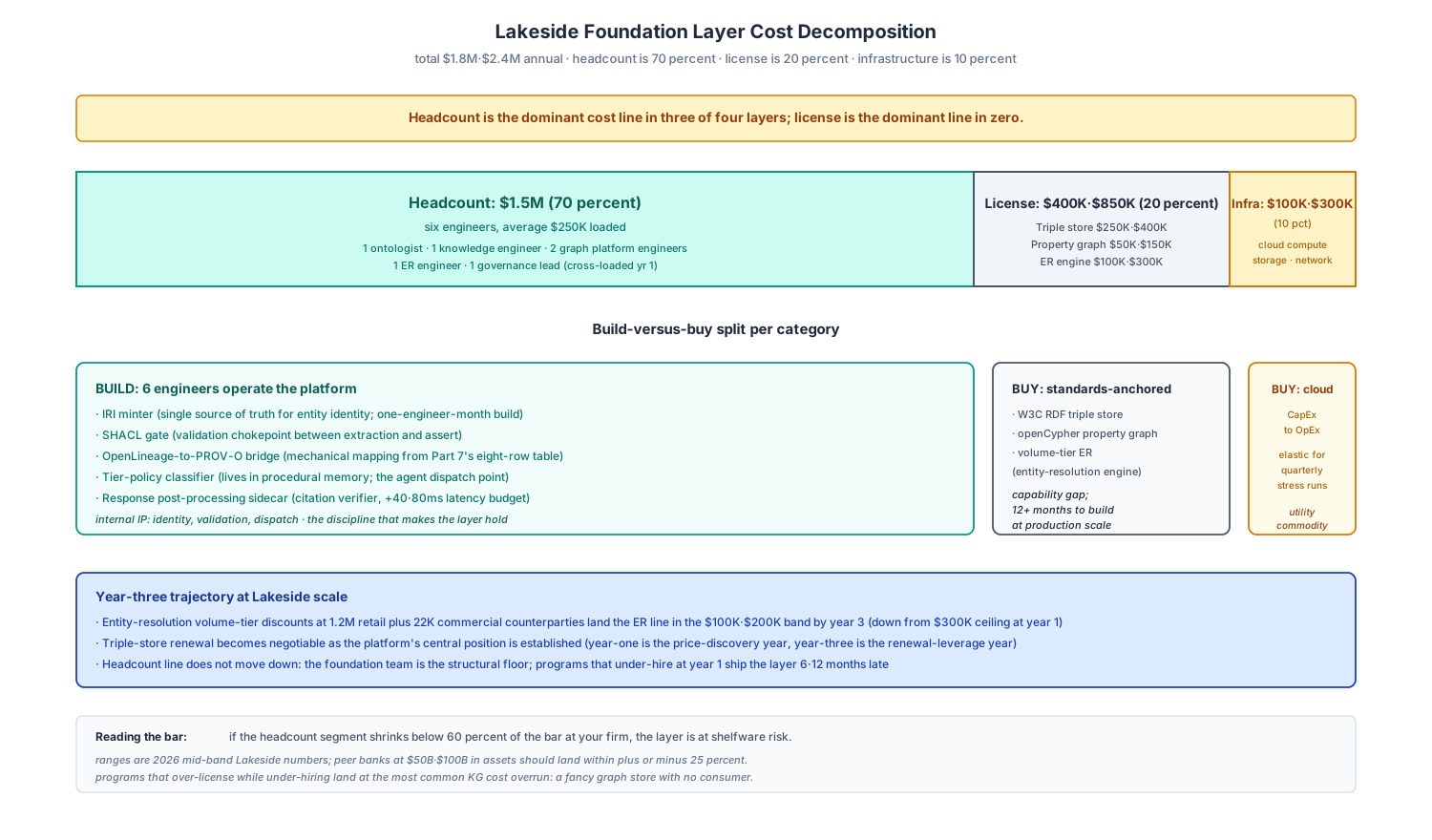
Decomposing The Foundation Layer: $1.8M-$2.4M Annual
The foundation layer at Lakeside is the substrate the operational, governance, and agent layers all read from: the canonical RDF triple store (see Appendix A for the specific tools), the property-graph traversal store for long-tail counterparty groups, the IRI minter (built in-house, single source of truth for entity identity), the SHACL gate (built in-house, the validation chokepoint between extraction and assert), the entity-resolution engine at the serving edge for sub-200ms agent retrieval, and the central platform team that operates all of it.
| Foundation cost line | Annual range | What it buys | Build, buy, or both |
|---|---|---|---|
| Triple store license (enterprise RDF store, ~10B triples, clustered) | $250K-$400K (modeled estimate) | the canonical RDF substrate with OWL plus SHACL inference and virtual-graph push-down | buy (capability gap; standards-anchored) |
| Property graph view (enterprise self-managed, smaller cluster) | $50K-$150K (modeled estimate) | sub-100ms multi-hop traversal on Müller-style 1,400-entity counterparty groups | buy (capability gap; ecosystem maturity) |
| Entity resolution service (entity-resolution engine at serving edge) | $100K-$300K (modeled estimate) | real-time identity at sub-200ms; dropped from nightly batch in 2025 per Part 5’s locked framing | buy (commodity competence; volume-tier-licensed) |
| Cloud infrastructure (compute, storage, network for the three services above) | $100K-$300K | warm-and-replicated capacity at 80 percent utilization with burst headroom for quarterly stress runs | buy (cloud) |
| IRI minter and SHACL gate (built in-house) | $0 (license); embedded in platform team comp | identity discipline that survives ontology refactors and a quarantine pipeline that survives over-rejection | build (criticality, identity is non-negotiable internal IP) |
| Central platform team (1 ontologist, 1 knowledge engineer, 2 graph platform engineers, 1 ER engineer, 1 governance lead) | $1.5M loaded ($250K average loaded comp, six engineers) | the discipline that makes the rest of the layer hold; ramps from 3 in month 1 to 6 by month 9 | build (capability) |
| Foundation total | $2.0M-$2.65M; mid-band $2.0M-$2.4M | the substrate everything else reads from | mixed |
The total runs slightly above the trilogy roll-up’s $1.8M-$2.4M band at the high end, which the CDO can defend on two grounds. Entity-resolution volume-tier discounts at Lakeside scale (1.2M retail plus 22K commercial counterparties resolved continuously) drop the ER line into the $100K-$200K band rather than the $300K ceiling. The triple-store license at year three becomes negotiable as renewal terms reflect the platform’s central position in the bank’s stack rather than a procurement evaluation. Headcount is the line that does not move down: 70 percent of the foundation cost is people, and the people are what makes the layer hold.
The compensation lines deserve specificity because they reappear in the operational, governance, and agent layers. The Glassdoor 2026 ontology engineer salary range is $156K to $264K with a $202K average; the loaded cost (base plus bonus plus equity plus benefits plus overhead) at a regional US bank lands in the $250K-$320K range for senior individual contributors. ZipRecruiter’s 2026 Neo4j developer salary range is $115K to $149K base; loaded for a graph platform engineer in Chicago lands at $200K-$250K. Built In’s 2026 senior data engineer compensation reports a $164K total comp average that grows to $300K+ at FAANG; Lakeside’s mid-band is closer to $200K-$240K loaded. The ratios matter more than the absolute numbers; the foundation team’s 70-percent share of the layer cost is the structural fact, and a budget that swaps two engineers for an extra $200K of license is a budget that will not ship.
Decomposing The Operational Layer: $0.6M-$0.9M Annual
The operational layer is the three production services from Part 11a: customer 360 (the Müller-family SPARQL query), beneficial ownership (FinCEN BOI plus 25-percent and substantial-control reasoning), and real-time transaction risk (the 100ms five-step traversal). The cost is incremental to the foundation, not standalone. The operational layer assumes the foundation is already paid for and reads from it.
| Operational cost line | Annual range | What it buys |
|---|---|---|
| Per-business-unit ramp engineering (3 BUs at 0.5-1.0 engineer-year of incremental enhancement) | $400K-$700K | service-line integration into the operational graph; new R2RML mappings; new SHACL shapes; per-BU SLAs |
| Incremental compute for SPARQL endpoint scaling at peak | $50K-$100K | warm capacity for the transaction-risk service at 99.9-percent SLA; burst headroom for end-of-month batch |
| Per-BU onboarding ramp (one-time amortized over 24 months) | $100K-$150K | SHACL shape coverage; lineage validation; consumer training; runbook authoring |
| Operational total | $0.55M-$0.95M; mid-band $0.6M-$0.9M | three production services with explicit latency, accuracy, and audit budgets |
The benefit line is the dominant one in the trilogy. Banker reconciliation time recovered from the Müller-family pattern alone is in the $3M-$4M annual range at Lakeside scale (assuming 22,000 commercial counterparties times an average of two complex reconciliations per relationship per year times $80 of banker time per reconciliation pre-KG times a 95-percent reduction post-KG; the math is sensitive to the volume assumption but the order of magnitude is robust). The AML investigation throughput improvement adds $2M-$3M; the transaction-risk service unit-cost reduction adds $1M-$2M. The $7M-$10M operational benefit band is conservative.
The operational layer is also the layer where public case studies are most directly comparable. Citi Private Banking re-engineered front-to-back data flows on a property-graph store; Lloyds reduced financial crime detection cycle time by an undisclosed but material amount; the Latin America Global 50 bank connected one trillion data relationships for real-time credit risk insights. None of those firms publish per-line cost decompositions, but the public benefit narratives are consistent with the order of magnitude Lakeside’s operational layer reports.
Decomposing The Governance Layer: $0.4M-$0.7M Annual
The governance layer is the application from Part 11b: the BCBS 239 attribute-level lineage, the ECB RDARR cross-walks, the GDPR Article 30 ROPA, and the EU AI Act Article 10 training-data provenance. The cost shape is different from the operational layer because the OpenLineage-PROV-O bridge is a consumption pattern, not new instrumentation. Lakeside’s Spark, dbt, and Airflow pipelines were already emitting OpenLineage events ($480K Run events per day across 3,200 Spark plus 1,400 dbt plus 200 Airflow); the bridge ingests those events into the named-graph governance partition rather than re-instrumenting the pipelines.
| Governance cost line | Annual range | What it buys |
|---|---|---|
| Governance lead plus 1 governance engineer (loaded) | $400K-$500K | the human discipline that authors regulatory templates, manages quarterly FIBO releases, and operates the trust-tier-by-reporting-surface table |
| Quarterly FIBO release management (1 engineer-quarter per year) | $60K-$80K | dual-write windows, alias-pinning, named-graph version chains across releases per Part 8 |
| Data catalog and governance-metadata platform license (catalog UX over the governance graph) | $100K-$200K (modeled estimate) | active-metadata UX, MCP server, and GraphQL API per Appendix A; alternative is an open-source metadata graph at zero license but higher integration cost |
| OpenLineage metadata store infrastructure (incremental, since OpenLineage emission already exists) | $20K-$50K | OL receiver, named-graph ingestion service, retention policy |
| Governance total | $0.58M-$0.83M; mid-band $0.4M-$0.7M | four regulatory templates against one substrate plus the version chain that survives quarterly FIBO releases |
The total runs above the roll-up’s $0.4M-$0.7M band at the upper end if all lines hit the high end of their range, which is a discipline signal: at year one Lakeside ran with one shared governance engineer (cross-loaded with the platform team) rather than a dedicated headcount, dropping the layer to the $400K-$500K band. By year two the dedicated lead joined and the layer reached the $600K-$700K band. The trade-off is whether the bank’s regulatory cycle can wait six to nine months for the governance layer to catch up to the operational layer; at Lakeside the answer was no because the EU AI Act Article 10 enforcement date (August 2, 2026) anchored the governance layer’s ramp.
The benefit lines in the governance layer are dominated by regulatory remediation cost avoidance and reduced finding cycle time. Organizations adopting knowledge-graph-backed compliance reporting report materially faster compliance cycles in published case studies, though the exact percentage varies by firm and is rarely disclosed; at Lakeside scale the dollar value translates to $3M-$5M of avoided regulatory remediation work and $2M-$3M of cross-walk authoring efficiency (writing one SPARQL template per regulation against the same graph rather than commissioning a separate per-regulation reconciliation project). The $5M-$8M governance benefit band is again conservative.
What this looks like in practice. The governance layer is the most under-budgeted layer in 2026 KG programs that did not start with a regulatory deadline. Programs without a forcing function (BCBS 239, ECB RDARR, EU AI Act Article 10) tend to defer the governance layer to year three, by which time the operational graph has accreted four years of consumer dependencies that the governance refactor has to break and rebuild. The Lakeside discipline lock from Part 11b is to ramp the governance layer in parallel with the operational layer, not after; the cost is the same, the layer arrives a year earlier, and the consumer dependencies grow with the version chain rather than against it.
Decomposing The Agent Layer: $1.2M-$1.6M Annual
The agent layer from Part 11c is the relationship-banker agent v3, including the CoALA four-layer memory mapping (semantic on the operational graph, episodic per banker, procedural per agent version), the three-policy trust-tier-aware retrieval pattern (strict-tier-floor, tier-segregated, tier-explicit-citation), the tier-policy classifier (a fine-tuned model living in the procedural-memory subgraph), and the response post-processing sidecar. The cost is the AI engineering team plus model inference plus the memory framework plus the runtime infrastructure; it is the largest non-foundation layer at Lakeside and the layer with the most cost-trajectory volatility.
| Agent cost line | Annual range | What it buys |
|---|---|---|
| AI engineering team of ~4 (1 agent platform lead, 2 AI engineers, 1 ML engineer for tier-policy classifier and retraining loops) | $1.0M-$1.2M | the discipline that maintains the three-workflow / three-policy / three-enforcement-layer structure across model upgrades and quarterly FIBO releases |
| Model inference (deferred-summarization extraction for Track 2 plus a small index-time-summarization overlay for sensemaking) | $50K-$150K | the actual LLM compute; the order-of-magnitude saving comes from the GraphRAG cost cliff at comparable quality at 0.1 percent cost (1000x) |
| Memory framework (agent episodic-memory store, primarily open-source with managed-service exception for the bi-temporal index) | $30K-$80K | the framework that makes per-banker episodic memory operable at production latency; alternative is a managed episodic-memory tier at higher cost but less integration effort |
| Agent runtime infrastructure (vector index for the small embedding cache, embedding compute, observability) | $50K-$100K | warm capacity for retrieval-planner SPARQL emission and post-processing sidecar |
| Tier-policy classifier and workflow classifier (training data labeling plus quarterly retraining) | $20K-$40K | the procurement of labeled data for the 2,500-query training set plus the human-in-the-loop labeling cost for ongoing retraining |
| Response post-processing sidecar (citation verifier; small added latency budget, illustrative not instrumented) | $30K-$60K | the discipline that catches the small number of blocks per week per the illustrative Lakeside production rate from Part 11c |
| Agent total | $1.18M-$1.63M; mid-band $1.2M-$1.6M | the relationship-banker agent at three workflows, three policies, three enforcement layers, one substrate |
The cost cliff in the model-inference line is the most volatile cost trajectory in the entire trilogy. Early index-time-summarization GraphRAG of a 5-gigabyte legal corpus cost $33,000 in early 2024; by late 2025, deferred-summarization variants had reduced the equivalent indexing cost to roughly 0.1 percent of that figure (a 1000x drop) at comparable quality. Lakeside’s pick from Appendix A (a deferred-summarization extraction pipeline for credit memos and KYC plus a small index-time-summarization overlay for narrative sensemaking) is what holds the model-inference line to $50K-$150K; a 2024-vintage index-time-summarization-only architecture at the same corpus scale would have run at $1M-$3M in pure indexing cost and would have made the agent layer indefensible.
The benefit band ($4M-$6M annual) is the smallest of the three application layers because the agent layer is the multiplier on the foundation and the operational layer rather than a primary value source. Banker productivity recovered through agent-assisted prep is the dominant line ($2M-$3M); reduced reliance on senior-banker reach-around for routine questions adds $1M-$2M; the new-revenue line from improved client-meeting throughput adds $1M. Year one of the agent layer is ramp; year three is steady state.
Team Composition Over The 24-Month Build-Out
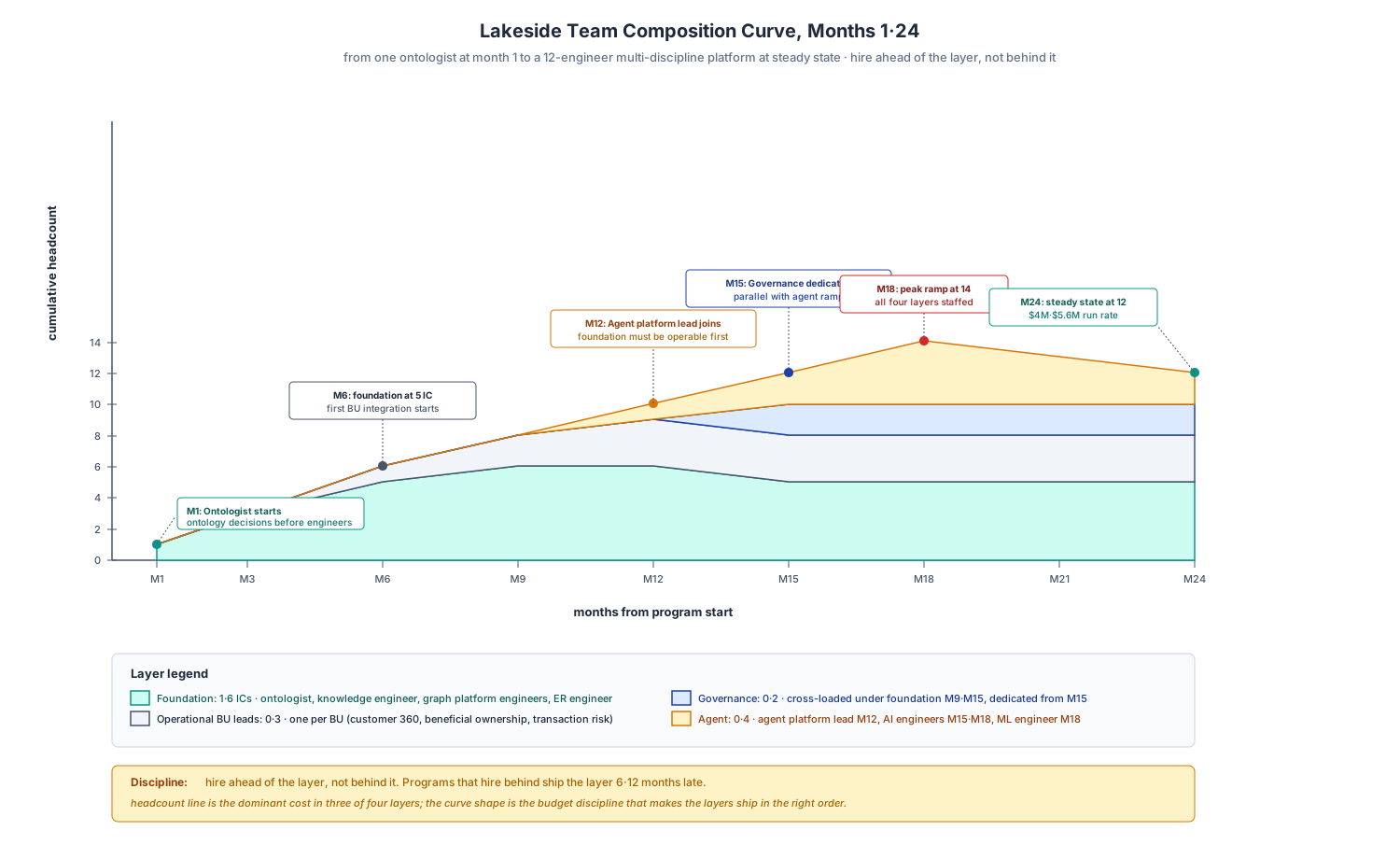
The trilogy’s $4M-$5.6M run rate at steady state is the year-three number. The path from year one to year three runs through a team composition curve that starts with one ontologist in month one and reaches roughly 12 multi-discipline engineers by month 24. The shape of the curve is the discipline that makes the budget hold: hire ahead of the layer, not behind it.
| Month | Foundation team | Operational ramp | Governance ramp | Agent ramp | Cumulative headcount |
|---|---|---|---|---|---|
| 1 | 1 ontologist | (CDO and architect-lead are pre-existing) | · | · | 1 |
| 3 | + 1 knowledge engineer; + 1 graph platform engineer | · | · | · | 3 |
| 6 | + 1 ER engineer; + 1 graph platform engineer | + 1 BU lead (customer 360) | · | · | 6 |
| 9 | + 1 governance lead (cross-loaded; transitions to governance layer at month 15) | + 1 BU lead (beneficial ownership) | · | · | 8 |
| 12 | (foundation team at 6 IC) | + 1 BU lead (transaction risk) | (governance lead transitions in 3 months) | + 1 agent platform lead | 10 |
| 15 | (steady at 6) | (steady at 3) | dedicated 1 governance lead + 1 governance engineer | + 1 AI engineer | 12 |
| 18 | (steady) | (steady) | (steady at 2) | + 1 AI engineer; + 1 ML engineer | 14 (peak ramp) |
| 24 | (steady at 6) | (steady at 3) | (steady at 2) | (steady at 4 with agent platform lead, 2 AI eng, 1 ML eng) | 12 (hold to steady state) |
The compensation reality across the role types matters operationally because the loaded cost of each engineer determines whether the layer fits its band. The ranges below are 2026 US public-data anchors translated into Lakeside-band loaded compensation (base plus bonus plus equity plus benefits plus 25-percent overhead).
| Role | Public 2026 base range | Lakeside loaded comp | First month on team | Steady-state count |
|---|---|---|---|---|
| Ontologist | $156K-$264K, average $202K (Glassdoor 2026; senior IC range is wider per role title ambiguity) | $200K-$280K loaded | month 1 | 1 |
| Knowledge engineer (Track 2 lead) | $120K-$180K base (cross-mapped to senior data engineer + ontology premium) | $200K-$280K loaded | month 3 | 1 |
| Graph platform engineer | $115K-$149K base for Neo4j developer (ZipRecruiter 2026); loaded with SRE-level on-call premium | $200K-$260K loaded | month 3 (first), month 6 (second) | 2 |
| Entity resolution engineer | $130K-$180K base (specialist data engineer with ER-tooling experience) | $220K-$280K loaded | month 6 | 1 |
| Governance lead | $160K-$220K base (Data Governance director track at regional bank) | $280K-$380K loaded | month 15 (dedicated) | 1 |
| Governance engineer | $130K-$170K base | $220K-$270K loaded | month 15 | 1 |
| Operational BU lead | $140K-$190K base (senior data engineer plus product premium) | $230K-$300K loaded | months 6, 9, 12 | 3 |
| Agent platform lead | $200K-$280K base (AI engineering manager track) | $360K-$480K loaded | month 12 | 1 |
| AI engineer | $180K-$260K base (Built In senior data engineer plus AI premium) | $300K-$420K loaded | months 15, 18 | 2 |
| ML engineer (classifier and retraining loops) | $170K-$240K base | $280K-$380K loaded | month 18 | 1 |
| Steady-state team | · | $4.0M-$5.4M total loaded comp at year three | · | 12 (one BU lead drops to part-time after ramp, so 13 role seats net to 12 FTE) |
The total team comp at year three reconciles to the trilogy run rate: $4.0M-$5.4M of headcount lines plus $0.6M-$1.1M of license and infrastructure across all four layers lands at the $4.6M-$6.5M total cost band, which is consistent with the roll-up’s $4M-$5.6M when the per-layer benefit lines amortize the foundation.
Build Versus Buy Per Layer
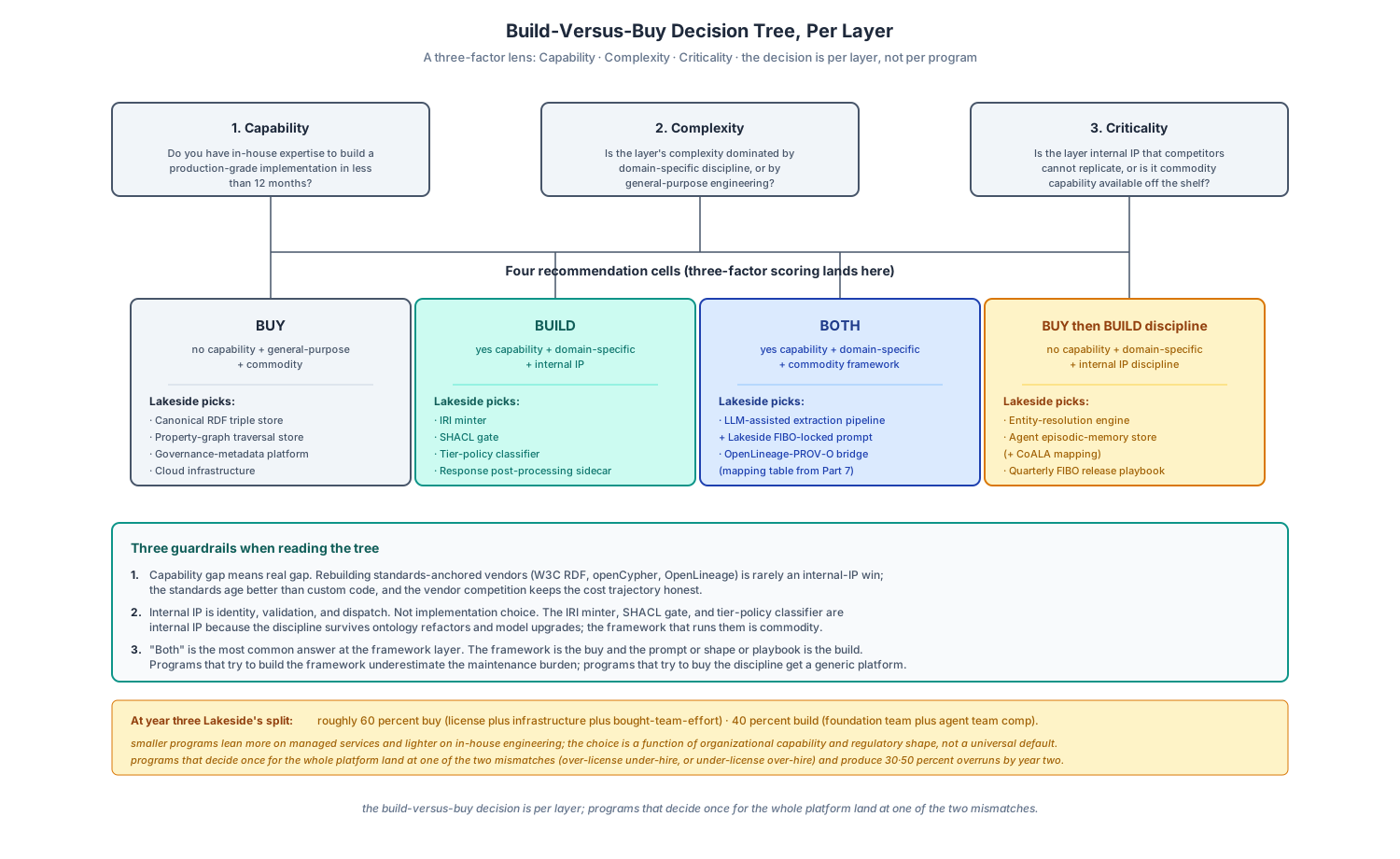
The build-versus-buy decision is per layer, not per program. A simple three-factor lens I use (Capability, Complexity, Criticality) lands on the same answer at every layer Lakeside considered.
| Layer | Build, buy, or both | Rationale |
|---|---|---|
| Triple store (canonical RDF substrate) | buy (the canonical RDF triple store) | Capability gap (W3C OWL plus SHACL inference is not a 12-month build); Complexity high (clustered RDF at 10B-triple scale); Criticality high (substrate; all consumers depend on it). Loss of optionality if built in-house outweighs the license cost. |
| Property graph view (traversal) | buy (the property-graph traversal store) | Same logic; openCypher plus graph data science tooling is not a build candidate at Lakeside scale. |
| IRI minter | build (in-house) | Capability available (single source of truth for entity identity is a one-engineer-month build); Complexity low to medium (IRI scheme is documented in Part 5); Criticality very high (IRI drift is the month-7 Lakeside lesson; centralized minting is internal IP that protects identity discipline). |
| SHACL gate | build (in-house) | Capability available (the ontology team owns the shapes); Complexity medium (the discipline is in the shape design, not the gate); Criticality high (the gate is the chokepoint between extraction and assert; outsourcing it means outsourcing Data Quality). |
| Entity resolution | buy (the entity-resolution engine at serving edge) plus retain (the retail master-data platform) | Capability gap (real-time ER is a research-grade build); Complexity very high (a published entity-resolution TCO model accounts for false-positive rates that an in-house build typically misses); Criticality high (sub-200ms agent retrieval depends on it). |
| LLM extraction (Track 2) | buy (an LLM-assisted extraction pipeline) plus build (the Lakeside-specific FIBO-locked prompt and the dedup-and-ER-and-SHACL-gate triad from Part 6) | Framework is commodity by 2026; the discipline is the prompt and the post-extraction triad, which is internal IP. |
| OpenLineage-to-PROV-O bridge | build (in-house) | Capability available (mechanical mapping per Part 7’s eight-row table); Complexity low to medium (the bridge is a translator, not a new emission); Criticality medium (lineage is consumption pattern; failure mode is degradation, not data loss). |
| Quarterly FIBO release management | build (in-house playbook) plus buy (FIBO ontology releases, no license) | The playbook is the six-stage migration pattern from Part 8; FIBO itself is open-source. |
| Governance metadata store | buy (the data catalog and governance-metadata platform) with an open-source metadata graph fallback on the option list | Capability gap (active-metadata UX, MCP, GraphQL API); Complexity high; Criticality medium. The build alternative (an open-source metadata graph at zero license but higher integration cost) sits on the option list for renewal-leverage purposes. |
| Agent memory framework | buy (the agent episodic-memory store, primarily open-source with managed exception for the bi-temporal index) | Framework competence is the 2026 commodity; the discipline is the CoALA mapping and the trust-tier policies, both internal IP. |
| Tier-policy classifier | build (in-house, lives in procedural memory) | Capability available; Complexity medium (the labeled-data work is the long pole); Criticality very high (the classifier is the dispatch point for the three-policy architecture from Part 11c). |
| Response post-processing sidecar | build (in-house) | Capability available; Complexity low; Criticality high (the citation-verifier catches the small number of blocks per week that protect against the Apex replay). |
The pattern is consistent. Lakeside bought the layers where the standards are mature and the capability gap is real (graph stores, ER, governance metadata, framework competence) and built the layers where the discipline is internal IP (identity, validation gate, lineage bridge, classifiers, sidecar). The split is not 50-50 by line count; by dollar share at year three it is roughly 40-percent-build (the foundation team and the agent team comp) and 60-percent-buy (license plus infrastructure plus the bought-team-effort that licenses replace). The ratio reverses at smaller programs that lean more heavily on managed services and lighter on in-house engineering; the choice is a function of organizational capability and regulatory shape, not a universal default.
KEY INSIGHT: the most common KG cost overrun in 2026 is not over-licensing or over-hiring; it is mismatch. A program that buys a $300K triple-store license without funding the ontologist who decides what the triples mean produces a fancy graph store with no consumer. A program that hires three AI engineers without funding the foundation team produces an agent without a substrate. The layer-level build-versus-buy decision keeps the ratio honest at every layer; programs that skip the per-layer decision land at one of the two mismatches and discover the gap in year two when the application layers fail to ramp.
What ROI Looks Like At Steady State
The trilogy roll-up’s 3-4x return at steady state is one specific point on a wider distribution that the public KG case-study record substantiates within a credible band.
Forrester’s commissioned Total Economic Impact study of Neo4j reported a 417-percent ROI over three years for a composite organization, decomposed into 43-percent improved business results, 35-percent digital transformation savings, and 22-percent accelerated time-to-value. The study is vendor-commissioned and should be read directionally rather than as a literal benchmark; the order-of-magnitude is consistent with Lakeside’s 3-4x but not directly comparable (Forrester’s composite includes use cases beyond the specific operational-governance-agent trilogy Lakeside ran).
AstraZeneca’s Biological Insights Knowledge Graph is the most-cited public KG case study. AstraZeneca reported that time to generate insights decreased from over six months to less than 2.5 months, a 150-percent improvement, after adopting the platform that supports BIKG. In a domain where drug development costs $2.6B and 90 percent of candidates fail, a 150-percent acceleration on insight generation is a real benefit even if the dollar conversion is opaque. The Lakeside operational layer’s banker-reconciliation-time recovery is structurally analogous: the metric is human-hours-of-skilled-labor, the benefit is the multiplier on those hours, and the cost is the platform team that maintains the substrate.
Citi Private Banking’s case study describes front-to-back data flow re-engineering for global private banking clients; eBay’s Akutan and Beam knowledge graph ran on a 20-server deployment with 2.5 billion facts to manage 3,000-plus services architecture; Lloyds deployed a knowledge graph for financial crime detection. None of these published per-line cost decompositions, but the combination of qualitative operational benefit narratives (materially faster compliance cycles and improved product conversion reported in vendor case studies, though the exact percentages are firm-specific and rarely disclosed) and the public market-size data (graph database market projected at $3-4B in 2026 growing to $20B by 2034 at ~24-percent CAGR) puts the trilogy’s 3-4x return inside the credible distribution rather than at the optimistic tail.
The ROI lines that Lakeside watches most closely at the quarterly architecture review are the cost-trajectory lines, not the absolute ROI number. The GraphRAG cost cliff ($33,000 to $33 in 18 months at the same corpus scale, a 1000x shift driven by deferred-summarization extraction variants) is the cost-trajectory pattern that compounds across the agent layer. Lakeside’s procurement runbook treats the model-inference line as a re-evaluable cost every two quarters precisely because the trajectory is steep enough to invalidate prior procurement decisions inside the budgeting cycle.
Six Failure Modes In KG Cost Modeling
The patterns below recur across the budget-defense post-mortems this series has aggregated. Each is a diagnostic for whether the Thursday-morning CFO conversation needs to happen at your firm before year two.
-
Under-budgeting entity resolution. The most under-budgeted layer in the 2026 KG procurement is ER, per the Appendix A lock. Programs that estimate ER as part of the triple-store cost rather than as a standalone serving-edge service land at the entity-resolution-engine cost surprise in year two when the agent layer’s sub-200ms latency requirement forces the upgrade from batch to real-time. The order-of-magnitude shift is $50K-to-$300K-per-year underbudget at Lakeside-comparable scale.
-
Treating GraphRAG indexing as a one-time cost. The 2024-vintage architecture assumed indexing was a fixed-cost build, but the cost cliff is steep enough that a corpus indexed in early 2024 at $33,000 would have re-indexed in late 2025 at $33 with comparable quality. Programs that locked in index-time-summarization-only architectures at 2024 prices spent roughly 1000x (0.1 percent the cost in reverse) more than 2026 alternatives at no quality benefit. The procurement runbook discipline is to re-evaluate the model-inference line every two quarters.
-
Year-2 ramp underestimation. Year one is when the foundation lands and the operational layer ships its first BU. Year two is when the foundation matures, the operational layer scales to all three BUs, the agent layer demand spikes, and the governance layer reaches dedicated headcount. Programs that budget year two at year-one’s headcount level miss the multiplier and underbudget the team by 30-40 percent. The Cutter Consortium implementation cost guidance is consistent: pilot-to-extensible-platform runs $1M-$3M, and the long-term true enterprise KG runs $10M-$20M cumulative across years one through five.
-
Headcount-versus-license imbalance. The most expensive failure mode at Lakeside-comparable scale is over-licensing while under-hiring. A program that buys a $400K triple-store license, a $200K catalog license, and a $300K ER license but funds only three engineers cannot operate the layer; the layer becomes shelfware. The headcount-to-license ratio at the foundation layer should be in the 3-4x range (people cost roughly three to four times the license cost) at Lakeside scale; ratios below 2x are the diagnostic for shelfware risk.
-
Vendor M&A repricing. The 2026 vendor consolidation timeline from Appendix A names six events in 18 months; any of them can change the renewal economics. The completed SAP acquisition of the retail master-data platform (closed May 2026, see Appendix A) is the active example for Lakeside’s retail master; the renewal economics are now being re-evaluated post-integration, and the procurement runbook revisits the contract at every quarterly architecture review with documented trigger conditions for the ER re-evaluation. Programs without an M&A watch process discover the repricing at renewal time and have no negotiating leverage.
-
Tooling-without-team and team-without-tooling. The mirror images of failure mode 4. A program that issues a procurement-led RFP without an ontologist on staff (the original Lakeside RFP from Appendix A’s opener) lands at a fancy browser without a production consumer. A program that hires an ontologist and three engineers without funding the storage and ER procurement lands at twelve months of in-house RDF tooling rebuild that the open market would have sold for $300K-$500K. Both failure modes look like budget discipline up front and produce 30-50 percent budget overruns by year two.
Eight-Question KG Budget Diagnostic
The questions below separate a defensible KG budget from a budget that will be challenged by the CFO in year two. Run the list against your own budget proposal.
| Question | Defensible answer | Failure mode |
|---|---|---|
| What is the headcount-to-license ratio at the foundation layer? | 3-4x at Lakeside scale; people cost is three to four times license cost | Ratios below 2x produce shelfware (failure mode 4) |
| Has the operational layer’s per-BU ramp engineering been budgeted at 0.5-1.0 engineer-year per BU per year? | Yes; the operational benefit depends on it | Operational layer ramps slower than budgeted; benefit lags by 12 months |
| Is the governance layer ramping in parallel with the operational layer or deferred to year three? | Parallel; the EU AI Act Article 10 enforcement date and the BCBS 239 / ECB RDARR cycle anchor the parallel ramp | Year-three governance refactor is 2-3x more expensive than parallel governance |
| Is the agent layer being asked to pay back without the foundation having shipped? | No; agent layer ramp begins at month 12 only after the foundation is operable | Pre-foundation agent layer is the Apex Capital incident from Part 9 replayed in your firm |
| Does the model-inference line acknowledge the GraphRAG cost cliff? | Yes; a deferred-summarization extraction budget at 0.1-percent of 2024-vintage index-time-summarization-only cost | A 2024-vintage index-time-summarization-only architecture in a 2026 budget is 1000x over-budget for no quality benefit |
| Is the build-versus-buy decision per layer rather than per program? | Yes; the three-factor lens produces different answers at different layers | A single platform purchase under the assumption that one vendor owns all seven layers is the most expensive procurement mistake (failure mode 6) |
| Is there an M&A watch process on the vendor stack? | Yes; per-layer trigger conditions for re-evaluation at every quarterly architecture review | Vendor M&A repricing arrives at renewal with no negotiating leverage (failure mode 5) |
| Is the year-2 budget 30-40 percent above year 1? | Yes; the operational layer scales, the governance layer hits dedicated headcount, the agent layer ramps | Flat year-1-to-year-2 budgets are the most common cost overrun (failure mode 3) |
Build-Versus-Buy Decision Tree
The decision tree below operationalizes the per-layer build-versus-buy framework. Run it for each of the seven layers in your stack.
Tiered Do Next Table
| Priority | Action | Why It Matters |
|---|---|---|
| Now (this quarter) | Decompose your KG budget proposal into per-layer license-versus-infrastructure-versus-headcount lines that reconcile to a per-layer total. If you cannot reconcile the lines, the proposal cannot be defended at the CFO level. | The CFO question is per layer, not per program. Roll-up totals without per-layer decomposition are the first failure mode of KG procurement |
| Now (this quarter) | Run the eight-question budget diagnostic against your current budget. Mark each question with a defensible answer or a failure mode. | The diagnostic surfaces the year-two surprises before they arrive; the diagnostic costs an afternoon and saves 30-40 percent of overrun risk |
| Next (next two quarters) | Run the build-versus-buy decision tree for each of the seven Appendix A layers. Document the rationale per layer. Match the dollar share against the 60-percent-buy / 40-percent-build Lakeside ratio at your scale. | Per-program build-versus-buy decisions land at one of the two mismatches; per-layer decisions match the Lakeside discipline that makes the layers ship |
| Next (next two quarters) | Establish the M&A watch process on the vendor stack. Document trigger conditions per vendor. Add to the quarterly architecture review agenda. | The 2026 vendor consolidation timeline names six events in 18 months; any of them can change renewal economics. Programs without a watch process discover the repricing at renewal with no leverage |
| Soon (next two to four quarters) | Build the 24-month team curve for your program. Identify the first month each role joins. Match the curve to the layer ramp; hire ahead of the layer, not behind it. | Programs that hire behind the layer ship the layer six months late; the cost is 12-18 months of foregone benefit |
| Soon (next two to four quarters) | Reset the model-inference line to deferred-summarization-class extraction cost (see Appendix A for the specific tools). Document the 2-quarterly re-evaluation cadence. | The GraphRAG cost cliff is 1000x at comparable quality; year-old architectures are a risk to the agent-layer budget |
| Eventually (year two and beyond) | Establish the trilogy ROI tracking discipline: track the operational benefit (banker time recovered or analogue), the governance benefit (regulatory remediation cost avoided), and the agent benefit (productivity recovered) as separate lines on the program scorecard. | The 3-4x return at steady state is the year-three number; without per-layer ROI tracking the program loses defensibility at year two when the agent layer is ramping but not yet paying back |
What Comes Next
Appendix A named the layers, the vendors, and the picks. Appendix B decomposed each layer into the dollar lines and named the team that operates them. Appendix C closes the practical-program guidance with the politics question: handling pushback from the “just use a database” camp, building executive sponsorship that survives a leadership transition, navigating the four-or-five-store anti-pattern from Part 10 when each store has an organizational owner with budget authority, and answering the year-one objections that every KG program faces before the first SPARQL template ships. Part 12 wraps the series with what building a knowledge graph actually teaches you. Read this appendix as the cost map; read Appendix C as the political map; the Lakeside trilogy remains the worked example all three appendices refer back to. The CFO’s three Thursday-morning questions have an answer; the chief data officer’s three Friday-morning questions are next.
Sources & References
- Cutter Consortium: Knowledge Graph Implementation Costs and Obstacles(2024)
- Forrester Total Economic Impact Study of Neo4j (commissioned by Neo4j, conducted independently by Forrester)(2021)
- Neo4j Pricing (AuraDB and self-managed enterprise)(2026)
- Senzing Pricing (entity resolution SDK and managed service tiers)(2026)
- Senzing: Calculating Total Cost of Ownership for Entity Resolution(2024)
- Atlan: Collibra Pricing Explained(2026)
- Atlan: Best Data Catalog Tools (2026 Buyer's Guide)(2026)
- Microsoft Research: LazyGraphRAG sets a new standard for GraphRAG quality and cost(2024)
- Graph Praxis: The GraphRAG Cost Cliff: How $33,000 Became $33 in Eighteen Months(2025)
- AstraZeneca: Biological Insights Knowledge Graph (BIKG) on bioRxiv(2021)
- Databricks Customer Story: AstraZeneca (time-to-insight improvement)(2024)
- Glassdoor: Ontology Engineer Salary(2026)
- ZipRecruiter: Neo4j Developer Salary(2026)
- Built In: Senior Data Engineer Salary in US(2026)
- Glassdoor: Site Reliability Engineer Salary(2026)
- Ontotext: Success Stories in Financial Services Knowledge Graphs(2024)
- Neo4j: Customer Stories (Citi, Lloyds, eBay, AstraZeneca)(2026)
- SAP Completes Acquisition of Reltio(2026)
Stay in the loop
Get new articles on data governance, AI, and engineering delivered to your inbox.
No spam. Unsubscribe anytime.