Operating a Knowledge Graph: Change, Versioning, and Evolution at Scale
A knowledge graph that cannot answer 'what did the graph say on the day the auditor pulled the report' is not in production. This article gives the operational architecture of a KG: bitemporal modeling, named-graph versioning, ontology release management with semantic versioning and OWL deprecation markers, SHACL-based backward compatibility verification, contract-based change management at the consumer boundary, and the migration playbook for ontology refactors. It covers what every change must preserve, how to evolve without breaking downstream agents, and the seven failure modes that turn a healthy graph into shelfware in eighteen months. Part 8 of the Knowledge Graph Practitioner's Guide.
Knowledge Graph Practitioner’s Guide: Overview | Part 1 | Part 2 | Part 3 | Part 4 | Part 5 | Part 6 | Part 7 | Part 8 | Part 9 | Part 10 | Part 11a | Part 11b | Part 11c | Appendix A | Appendix B | Appendix C | Part 12
The Rename That Broke Fourteen Consumers
A regional property and casualty insurer we will call Sentinel Mutual, a composite drawn from publicly documented failure patterns, ran its claims and underwriting analytics on a knowledge graph that had been live for almost three years. The graph was internally well-regarded. SHACL shapes covered the core entities. PROV-O metadata was attached at the named-graph level. The four-tier trust model from Part 7 was in production. By every internal scorecard, the KG was healthy.
In a routine ontology refresh, the modeling team renamed one predicate. The class formerly known as sm:policyOwner became sm:policyHolder to align with regulatory language and to make room for a more nuanced beneficiary model that the legal team had requested. The change shipped in a Friday release. The team updated the SHACL shapes, ran the OWL reasoner against the new module, and saw clean validation. They marked the change additive plus rename in the release ticket and went home.
By Tuesday morning, fourteen downstream consumers had broken. The relationship-banker chatbot returned empty results for the most common query path. A regulatory report failed silently and produced a NULL count for active policies. The actuarial team’s Cypher exports went from forty thousand rows to zero. The fraud-screening agent started flagging legitimate policies as orphaned because the relationship that previously connected a customer to their policy no longer existed under the predicate the agent had been trained on. None of the SHACL shapes failed. None of the OWL constraints triggered. The graph was structurally pristine and operationally on fire.
The team rolled back the change in three hours. The post-mortem took three weeks. The finding, in the same shape that the data contracts article had described months earlier, was familiar: a producer had treated an ontology revision as an internal refactor. Fourteen consumers had bound to the old predicate. None of them had been notified. None of them had migration paths. The KG was healthy, and the operational discipline around the KG was not.
This is the core failure mode that Parts 1 through 7 cannot prevent on their own. The graph in Part 5 has correct identity. The construction in Part 6 has correct mappings. The trust layer in Part 7 has correct provenance. None of that survives a sloppy rename. This article is about the operational architecture that makes change safe.
Operations Is Where Most KGs Quietly Die
The Geisler et al. VLDB 2025 vision paper on managing knowledge graph ecosystems through life cycles makes a point that is rarely stated directly, restated plainly here: a KG is not a static artifact. It is a continuously evolving system whose data, ontology, mappings, reasoners, validators, and consumers all change at different cadences. Each of those layers can change independently. If the change discipline only covers one layer, the others compound silently. By month thirty, the graph has accumulated enough operational debt that it can no longer be safely changed at all, which is when teams quietly switch to a “rebuild from scratch” project that never ships.
Part 8 covers four operational moves that, together, prevent that outcome.
| Move | What it solves | Where it lives |
|---|---|---|
| Bitemporal modeling | ”What did the graph say about Alice on April 1, even after we corrected the data on April 7?” | At the triple or named-graph level, depending on paradigm |
| Named-graph versioning | ”Which version of the graph produced this number?” | At the named-graph level, with version IRIs |
| Ontology release management | ”Which version of the vocabulary is this triple committed against?” | At the ontology level, with owl:versionIRI and SEMVER |
| Contract-based change at the consumer boundary | ”Who depends on this term, and what is their migration window?” | At the producer-consumer interface, with data contracts |
These four moves are not optional. A graph that lacks any one of them fails operationally even when it is structurally and semantically correct.
Bitemporal Modeling: Two Clocks, Not One
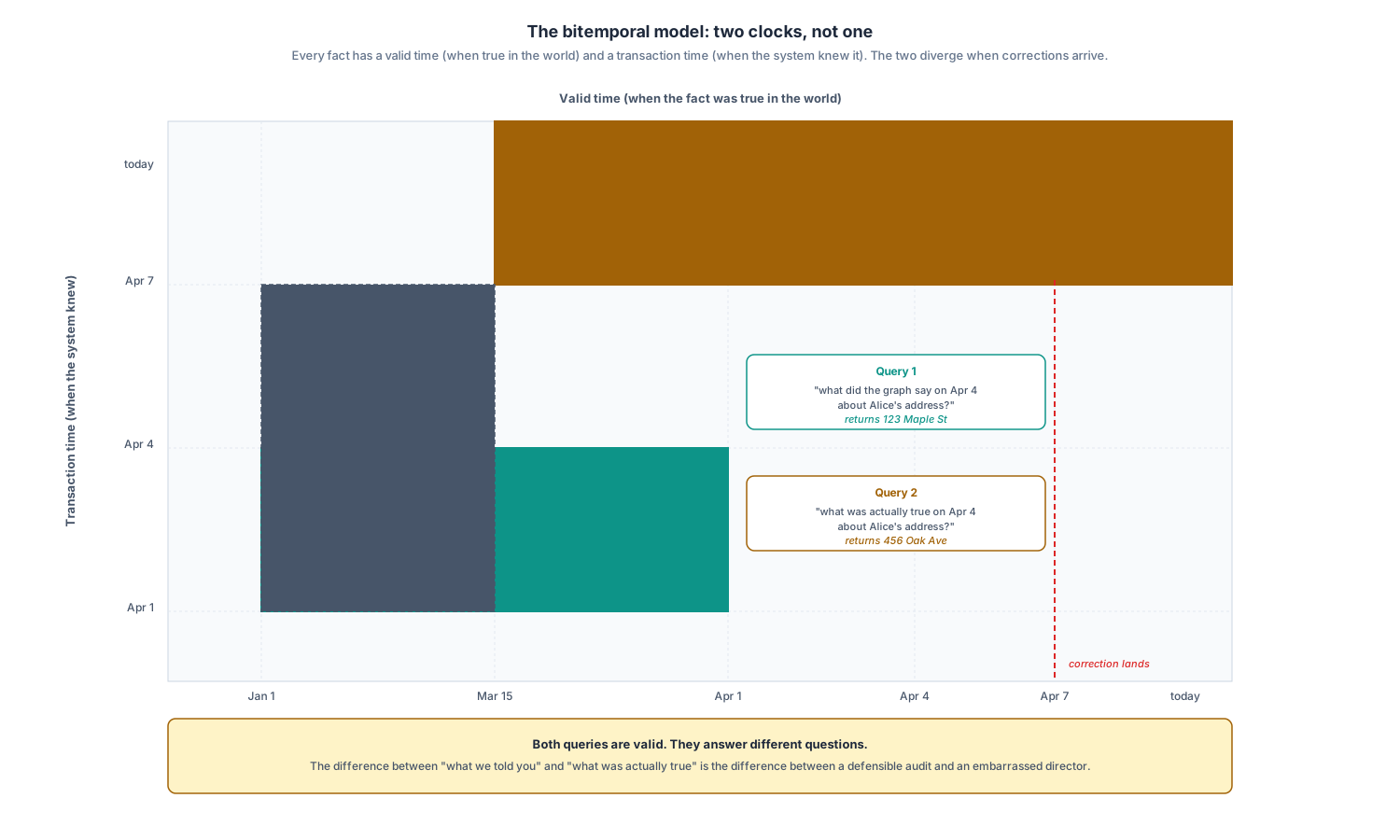
The first move is to stop pretending a KG has one clock. Every fact in a KG actually has two: the time the fact was true in the world (valid time) and the time the system recorded it (transaction time). A graph that only tracks one of them cannot answer the questions that auditors, regulators, and AI agents actually ask.
The classic example. On April 1, the graph asserts that Alice’s address is 123 Maple St. On April 7, the team discovers that Alice actually moved on March 15, so they update the address to 456 Oak Ave. A graph with one clock sees this as “the address changed on April 7” and cannot reconstruct what it told the chatbot when a customer service call happened on April 4. A graph with two clocks records: “from March 15 forward (valid time), the address is 456 Oak Ave, and the system learned this on April 7 (transaction time).” Now the April 4 call is auditable. The chatbot’s answer at that moment is reproducible. The discrepancy between “what we told you” and “what was actually true” is queryable rather than embarrassing.
The 2025 BiTemporal RDF (BiTRDF) model paper in Mathematics treats every RDF resource and relationship as inherently bitemporal. Every triple carries valid-time and transaction-time annotations. The trade-offs are explicit: bitemporal modeling materially increases the storage footprint of the graph (a practitioner rule of thumb is roughly a doubling, not a figure the paper measures) and requires every query to be temporally scoped, which complicates SPARQL and Cypher considerably. The 2024 ConVer-G work takes a related approach for concurrent versioning of evolving urban knowledge graphs, where multiple versions of the same fact must coexist and be queryable side by side.
In production KGs, three implementation patterns dominate.
| Pattern | How it works | When it fits | Cost |
|---|---|---|---|
| Triple-level temporal annotations (BiTRDF, RDF-star with valid-time and transaction-time tuples) | Every triple carries validFrom, validTo, recordedFrom, recordedTo | High-precision audit needs (regulated finance, healthcare claims) | High storage, complex queries |
| Named-graph per snapshot or per change set | Each release lands as a named graph; queries use the most recent or a specified version IRI | Most enterprise KGs; aligns with OWL versioning and PROV-O | Moderate storage, simpler queries |
| Bitemporal property graph (LPG with timestamp properties on edges) | Edges carry validFrom, validTo, recordedAt; queries filter on timestamp | LPG-native deployments where property graphs are the storage model | Moderate storage, requires query discipline |
The named-graph-per-snapshot pattern is the production default in 2026 enterprise KGs. It composes cleanly with the named-graph-plus-PROV-O scaffolding established in Part 7. It does not force every triple to carry timestamps. It lets queries take a default “current” view (just query the latest named graph) while still allowing time-travel queries against prior named graphs.
The most common bitemporal failure is the opposite of overengineering. Teams build a graph with one clock, ship it, and only realize they needed two when an examiner asks “what did this report say on the date you sent it.” By that point, retrofitting valid-time-versus-transaction-time discipline costs roughly the same as rebuilding the ingestion pipeline.
What this looks like in practice. If your KG feeds any artifact that is sent to a regulator, a customer, or a court, you need two clocks. Decide whether to model bitemporally at construction time. Adding it after the graph is in production is a multi-quarter project, not a sprint.
Named-Graph Versioning: One Graph IRI Per Release
Bitemporal modeling answers the data-level question. Named-graph versioning answers the structural question: which version of the entire graph (or subgraph) was in effect when a query ran.
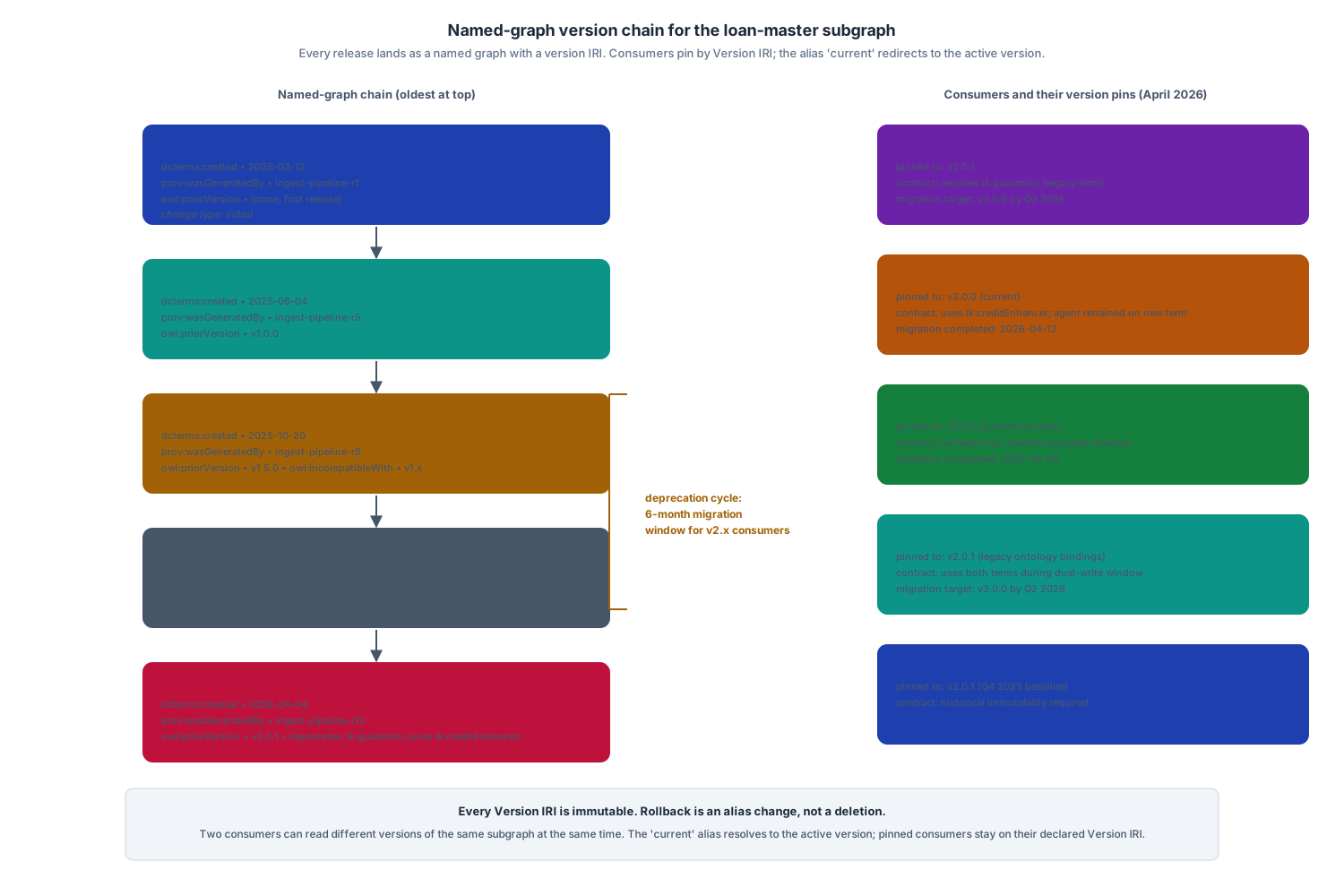
The pattern is mechanical. Every release of every subgraph (a vocabulary module, an ingest from a specific source, a derived view) lands as a named graph with its own IRI of the form https://lakeside.com/graph/loan-master/v1.7.2. Each version of the named graph carries a small metadata block: dcterms:created, prov:wasGeneratedBy linking to the activity that produced it, owl:priorVersion linking to the previous named graph, and prov:wasDerivedFrom linking to the source artifacts. Queries that need a specific version address it by IRI; queries that want the current view bind to a stable alias (https://lakeside.com/graph/loan-master/current) that the platform redirects to the active version.
This is the production answer to four operational questions a KG must be able to answer.
| Question | How named-graph versioning answers it |
|---|---|
| What version of the loan ingest produced this number? | The named-graph IRI is recorded on the derived triple as a PROV-O prov:wasDerivedFrom chain |
| Which version of the counterparty hierarchy was in effect on April 4? | The named-graph alias current resolved to v3.1.4 on April 4, recorded in the platform’s alias log |
| Can two consumers read different versions of the same subgraph at the same time? | Yes. They bind to different version IRIs explicitly, or pin to a date and let the platform resolve |
| If we roll back the latest release, what triples disappear and what triples come back? | Every version IRI is immutable. Rollback is an alias change, not a deletion |
Versioning the graph at the named-graph level (one version IRI per release) is the load-bearing primitive once multiple independent teams produce into the same KG; as a practitioner heuristic, the pain becomes acute somewhere past three independent producers. The 2024 ConVer-G framework operationalizes the multi-version querying problem (querying across many named graphs at once) for use cases like change-impact analysis and “diff this version against that version.”
A subtlety. Named-graph versioning at the granularity of “the whole graph” does not scale because no real KG releases atomically. The unit of versioning should match the unit of release: a vocabulary module (FIBO LOAN), an ingest pipeline (CRM customer master extract for cycle 2026-04), a derived view (counterparty exposure rollup), or a regulatory report subgraph (BCBS 239 risk submission for Q1). The platform tracks the alias-to-version mapping for each unit independently.
What this looks like in practice. A graph store that does not give you per-named-graph metadata (creation timestamp, prior version, generating activity) is not a production-grade KG store. Adding this scaffolding after the fact is one to two quarters of work.
Ontology Release Management: Vocabularies Are Products
The third move is the one most teams underrate: treating the ontology itself as a versioned product with consumers, semantic versioning, deprecation rules, and changelogs.
OWL 2 provides the structural primitives. Every ontology has an Ontology IRI (the stable identity, e.g., https://lakeside.com/onto/loan) and a Version IRI (the specific release, e.g., https://lakeside.com/onto/loan/2026/04). The same constructs that mark a class as deprecated (owl:deprecated true) and link a release to its predecessor (owl:priorVersion, owl:backwardCompatibleWith, owl:incompatibleWith) are stable W3C-defined predicates. The mechanics are not the issue. The discipline is.
The discipline has five parts, well-summarized in Ben Kass’s Enterprise Knowledge piece on managing and versioning an ontology and reflected in mature ontologies like FIBO, which now publishes quarterly releases with per-module changelogs and explicit deprecation paths.
| Discipline | What it means in practice | What it prevents |
|---|---|---|
| Track version inside the ontology | owl:versionIRI, owl:versionInfo, dcterms:created, dcterms:modified on the ontology header | Consumers binding to “the ontology” with no idea which version they got |
| Use semantic versioning | MAJOR.MINOR.PATCH; MAJOR for breaking changes (rename, remove, change cardinality), MINOR for additive changes (new class, new property), PATCH for editorial fixes | Consumers having no signal that an upgrade is risky |
| Deprecate before removing | Mark the term owl:deprecated true for at least one MAJOR cycle before deleting; leave it queryable so legacy consumers do not break overnight | Sudden removals breaking active consumers |
| Maintain a changelog | Per-release human-readable list of additions, deprecations, removals, and notes; FIBO’s release notes are the canonical example | Migration ambiguity (“I think this changed but I am not sure”) |
| Serve both Ontology IRI and Version IRI | The Ontology IRI redirects to current; Version IRIs serve immutable archives | Consumers being unable to pin to a specific version when they need stability |
The 2025 K-CAP paper Lessons Learned from the Combined Development of OWL and SHACL reinforces this from the validation side: in production ontologies that combine OWL for inference with SHACL for validation (the 2026 enterprise default established in Part 4 and Part 7), the version of the OWL ontology and the version of the SHACL shape file must move together, with explicit cross-references. A SHACL shape file at v3.2.0 should declare the OWL ontology version it validates against. Decoupling the two is a recipe for drift.
A worked example. Lakeside Trust Bank’s loan ontology is at version 2.4.3 in March 2026. The team plans to add a new property lk:syndicationLeadAgent to model syndicated loan participations. This is additive: nothing breaks, nothing renames. The release lands as 2.5.0 (MINOR bump). In June 2026, the team plans to rename lk:guarantor to lk:creditEnhancer to align with a hypothetical FIBO LOAN terminology shift in this worked example. This is breaking. The release lands as 3.0.0 (MAJOR bump) with lk:guarantor owl:deprecated true and an explicit owl:priorVersion link, and the changelog calls out the rename plus the migration path. Active consumers have until version 4.0.0 (the next MAJOR cycle, target Q1 2027) to migrate. Version 2.5.0 and 3.0.0 are both served simultaneously by Version IRI; the current alias points to 3.0.0.
This is what “ontologies are interfaces” actually means. Without these five disciplines, every ontology change is a Sentinel Mutual incident waiting to happen.
For practitioners: an ontology is an interface, and interfaces have versions, deprecations, and migration windows. The day a second team binds to your vocabulary, you no longer own a configuration file; you own a published contract. Treat every rename, removal, or cardinality change as a MAJOR release with a deprecation cycle, or accept that some Tuesday morning a consumer you did not know existed will break.
Schema Evolution Under SHACL: The Backward Compatibility Check
The fourth piece is a verification problem. When the SHACL shapes change (because the ontology changed, or because the team tightened a constraint, or because the validator caught a class of violations), the question is: will every triple that was valid yesterday still be valid today?
The 2025 ISWC paper SHACL Validation Under Graph Updates by Ahmetaj, Konstantinidis, Ortiz, Pareti, and Simkus formalizes this question and gives a static-analysis answer. Given a SHACL shape graph S1, an update sequence (or a new shape graph S2), and a class of graphs that satisfied S1, the framework can verify whether all such graphs will also satisfy the updated constraints. The implementation is a prototype tool, not yet production-grade, but the conceptual contribution is what production teams need: a precise statement of the backward-compatibility check.
In production today, teams approximate the same check operationally. Three patterns dominate.
| Pattern | What it does | When it suffices |
|---|---|---|
| Differential shape diff | Diff the SHACL shape file between versions; flag any new constraint, tightened cardinality, narrowed datatype, or added required property as potentially breaking | Most enterprise teams; fast and integrates into CI |
| Replay validation | Re-run the new SHACL shapes against a representative slice of the existing committed graph; any new violations are blocking until resolved | When the shape change is non-trivial; catches semantic drift the diff misses |
| Partition-aware validation | Apply the new shapes only to triples committed after the shape release; older named graphs are validated against their original shapes | When the cost of retroactive validation is prohibitive; common in very large KGs |
The third pattern requires that every named graph carry a reference to the SHACL shape version it was validated against. This becomes a seventh field, extending the six-field provenance contract from Part 7 into a seven-field contract: where, what process, who, when, trust level, source hash, and now validatedAgainstShapes. Every later reference in this article uses the seven-field contract. Without it, retrospective audits cannot reproduce the validation context.
The most dangerous SHACL change is the one that looks safe and is not. Tightening sh:minCount 0 to sh:minCount 1 looks like a bug fix. It silently invalidates every existing entity that was missing the property, which is potentially every entity ingested before the upstream pipeline started populating it. The differential shape diff pattern catches this; the unmodified replay pattern reports it as failures and forces the team to decide. Pattern three sweeps it under the rug, which is exactly why some teams use it and exactly why other teams forbid it.
Data Contracts as the Consumer Boundary
The first three moves are internal to the KG. The fourth is at the boundary. When a downstream system (a regulatory report, a chatbot, an agent, a BI dashboard) binds to a class, predicate, or named graph, that binding is an interface contract. Without an explicit contract, the producer team is free to change the term and the consumer team has no signal until production breaks.
The full treatment of contract-based change management is in Data Contracts: A Change Management Guide. The KG-specific contract surface differs from the typical relational data-contract surface in three ways.
| Contract surface | Relational version | KG-specific version |
|---|---|---|
| What is contracted | Table + column names + types | Class IRIs, property IRIs, named-graph IRIs, expected SHACL shape compliance |
| Versioning unit | Schema version per table | Ontology version + SHACL shape version + per-named-graph version |
| Backward-compatibility test | Schema diff plus compatibility rules (avro, protobuf) | Ontology diff plus SHACL diff plus query-replay test against representative consumer queries |
As of the v3.1.0 release, the 2025 Open Data Contract Standard (ODCS) does not yet have first-class support for KG terms, so most KG teams in 2026 are extending ODCS contracts with custom blocks for ontology-version, shape-version, and named-graph-version pinning. The exact extension is less important than the practice. Any consumer binding to the KG must declare which terms it depends on, which version it pins to, and how it is notified of upgrades.
The minimum viable KG contract has six elements:
- The Ontology IRI and Version IRI(s) the consumer binds to.
- The named-graph IRIs (or aliases) the consumer reads from.
- The class and predicate IRIs the consumer’s queries depend on.
- The SHACL shapes the consumer expects compliance with.
- The migration window for any breaking change (the producer commits to maintain the prior version for at least N months).
- The notification channel for proposed changes (mailing list, RFC repository, slack channel, ticketing queue).
A contract with all six elements turns the Sentinel Mutual incident into a non-incident: the rename would have surfaced as a change request against fourteen contracts, each with a migration window and a notification trigger, weeks before the deploy.
The Migration Playbook: Ontology Refactors Are Multi-Quarter Projects
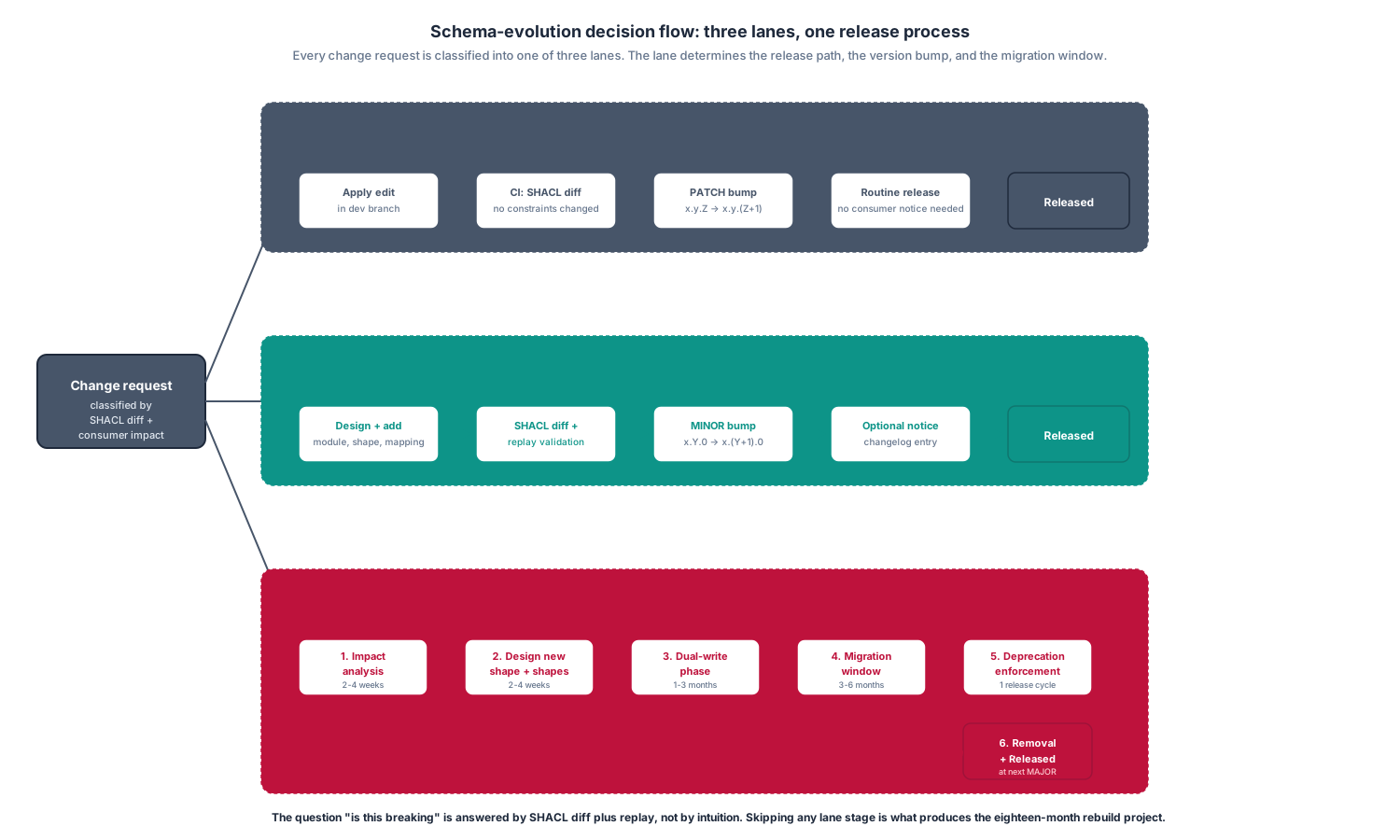
Most KG changes are easy. Adding a property is a MINOR bump. Adding a class is a MINOR bump. Editorial fixes are PATCH bumps. The hard change is the refactor: renaming a class, splitting one class into two, merging two classes into one, changing the cardinality or domain of a property, or replacing a custom term with an imported FIBO term.
The migration playbook for a refactor has six stages, and skipping any of them is what produces the eighteen-month rebuild project.
| Stage | What happens | Typical duration |
|---|---|---|
| 1. Impact analysis | Inventory every consumer binding to the affected term. Gather contracts (or build them retroactively). Identify SHACL shapes, downstream views, agent prompts, BI dashboards, regulatory reports. | 2-4 weeks |
| 2. Design the new shape | Define the target ontology version. Specify the deprecation rules (old term remains, marked owl:deprecated true, queryable for one MAJOR cycle). Specify the new SHACL shapes. Write the changelog entry. | 2-4 weeks |
| 3. Dual-write phase | Producer pipelines emit both the old and new terms. Both shapes validate. Both named graphs are populated. Consumers continue using the old term. | 1-3 months |
| 4. Migration window | Notify consumers. Each consumer migrates on their own schedule, within the agreed window. The migration is from old term to new term, with the dual-write phase guaranteeing no data loss. | 3-6 months |
| 5. Deprecation enforcement | At the end of the migration window, the old term is hard-deprecated. New writes against the old term are rejected. Reads against the old term still work but emit a deprecation warning. | 1 release cycle |
| 6. Removal | At the next MAJOR ontology release, the old term is removed. Historical named graphs that contain the old term are not modified (they are immutable); they are marked as bound to a prior ontology version. | 1 release cycle |
A refactor that respects this playbook is a six-to-twelve-month effort. A refactor that ignores it is a Friday deploy that breaks fourteen consumers. The cost of the playbook is real; the cost of skipping it is at least an order of magnitude higher. Sentinel Mutual’s three-week post-mortem covered roughly half of stages 1, 2, and 5, all done after the fact.
What this looks like in practice. When a stakeholder demands a refactor on a sprint timeline, the answer is not “yes” or “no.” The answer is: “Here is the six-stage playbook. Which stages do you want to fund, and which migration windows are you willing to wait through.” If the stakeholder cannot answer, the refactor is not yet a project.
Trust Tiers Survive Operations (or They Are Theater)
Part 7 introduced the four-tier trust pattern (gold, silver, bronze, quarantine) and the six-field provenance contract that this article extended to seven fields. Operations is where that pattern is tested. Every operation must preserve the trust tier and the provenance metadata; an operation that strips them is a silent quality regression, even if the structural validation still passes.
Three operational rules.
| Rule | What it requires |
|---|---|
| Migrations preserve trust tier | When a triple is rewritten under a new term during a refactor, the new triple inherits the prior triple’s trust tier. The dual-write phase emits both at the same tier. If the new term cannot be derived without lowering the tier (e.g., the new term requires data the source did not provide), the operation must explicitly demote the tier and record the reason in PROV-O. |
| Reasoner upgrades version-tag inferences | When the OWL reasoner is upgraded (new profile, new rules, new version of the reasoner engine), all materialized inferences are re-derived. Inferences carry the reasoner version in their PROV-O activity. A consumer reading a materialized triple can know which reasoner produced it. |
| Validator changes record the shape version | Every triple validated by SHACL records the SHACL shape version it was validated against. Retrospective re-validation under a new shape version creates a new validation activity, not a silent overwrite. |
The “trust survives operations” property is the one that production audits actually test. An auditor pulling a number from last quarter’s report wants to know: which trust tier was this triple at the time of the report, which ontology version, which SHACL shape version, which reasoner version. If any of these were upgraded after the report ran and the metadata cannot reproduce the prior state, the audit fails. Bitemporal modeling, named-graph versioning, ontology release management, and operational provenance are the architecture that makes the audit pass.
The OpenLineage Bridge for Operational Lineage
The KG-internal versioning machinery (named-graph IRIs, ontology versions, SHACL shape versions) describes change inside the graph. It does not describe change in the upstream systems that feed the graph. When a CRM source schema changes, when an LLM extraction model is retrained, when an R2RML mapping is updated, that change is upstream of the graph but causally connected to it. Without a bridge, the audit trail stops at the graph boundary and the team cannot answer “why did the numbers change.”
The bridge pattern, established in Part 7, is to model OpenLineage events as PROV-O activities inside a designated provenance named graph. Each pipeline run that produces or transforms a graph subgraph emits an OpenLineage event; the platform converts the event to a PROV-O activity that links the source datasets, the transformation, and the resulting named graph. The KG can then be queried for “what produced this triple” with a chain that crosses the graph boundary into upstream pipelines, all the way back to the source system.
Operationally, this means three things. First, the upstream pipeline change (a CRM schema bump, a mapping rename, a model retrain) is recorded in the same audit substrate as the in-graph change. Second, an in-graph regression can be triaged by walking the lineage chain backward; a number that changed in the regulatory report can be traced to a specific upstream event. Third, the operational impact-analysis question (“what consumers are at risk if we change this CRM table”) becomes a graph query rather than a tribal-knowledge exercise.
Seven Failure Modes That Show Up in Year Two
Each failure mode below recurs in production KGs and is consistent with the life-cycle pressures the Geisler et al. VLDB 2025 vision paper describes; several map to challenges reported across KGC conference talks in 2024-2026.
| Failure | What it looks like | Root cause |
|---|---|---|
| Silent rename | Consumers break overnight when a producer renames a term without notice | No data contract; no deprecation cycle; ontology treated as internal config |
| One-clock graph | Auditor cannot reconstruct what the graph said on date X; team rebuilds lineage by hand | Bitemporal modeling deferred at construction time; retrofit is a quarter-plus project |
| Atomic-graph versioning | Whole-graph versioning that does not match the unit of release; teams stop versioning because it is too coarse | Versioning unit chosen at the wrong granularity (whole graph vs vocabulary module vs ingest vs derived view) |
| OWL/SHACL drift | Ontology and validation rules move on different release cadences; constraints stop matching the model | OWL and SHACL versions not pinned together; no cross-reference between shape file and ontology version |
| Reasoner-induced regression | A reasoner upgrade silently changes materialized inferences; downstream agents see different answers for the same query | Reasoner version not recorded in PROV-O on materialized triples; no re-validation pass on upgrade |
| Trust tier laundering | Operations rewrite triples under new terms but lose tier metadata; bronze content silently surfaces in gold reports | Migration code did not propagate trust tier through dual-write |
| Contract-less consumer | A new consumer (often an agent) starts reading the graph without a contract; producer changes break it | No discovery surface for “who reads this term”; consumer onboarding skipped contract step |
The pattern across all seven is the same. Each one is the result of an operation that did not preserve some piece of metadata that production needed. The fix in every case is to make the metadata mandatory in the operation’s tooling, not in policy.
A Decision Tree for the Operations Layer
Use this when you are asked to plan, scope, or review a KG change. It is a runtime decision tree; treat it as a checklist for any non-trivial change.
- Is this change additive, editorial, or breaking? Editorial: PATCH. Additive: MINOR. Breaking (rename, remove, narrow cardinality, change domain or range, restrict a property): MAJOR.
- If breaking, who are the consumers and what are they bound to? Inventory contracts. If contracts do not exist, build them retroactively before the change.
- What is the deprecation cycle and migration window? Default: one MAJOR cycle deprecation, three to six months migration. Negotiate with consumers, not assume.
- Does the SHACL shape diff produce new constraints, tightened cardinalities, or narrowed datatypes? If yes, run replay validation against a representative slice. Resolve any new violations before the release.
- Is the OWL ontology version pinned to a specific SHACL shape version? If they move on different cadences, fix the cross-reference before shipping.
- Does the reasoner upgrade re-derive materialized inferences with version-tagged provenance? If not, the upgrade should be blocked.
- Does every named graph (or named-graph alias change) carry the seven-field provenance contract (the six fields from Part 7 plus the validatedAgainstShapes field)? If not, the operation is not auditable.
- Is the trust tier preserved through every transformation? If a transformation cannot derive the new term at the same tier, demote and record the reason.
- Is the change traceable end-to-end via OpenLineage plus PROV-O? If the upstream pipeline event is not bridged into the KG’s provenance graph, the audit chain breaks at the boundary.
- What is the rollback? Every release must have a documented rollback that is an alias change, not a deletion. If the rollback requires data restoration, the release is not safe to ship.
A change that passes all ten questions is a change that production can absorb. A change that fails any of them is a change that will surface as an incident eventually.
What This Article Did Not Cover
Three operational topics deserve more depth than fits here and will appear in subsequent parts.
- KG-for-agent runtime drift, where the agent’s understanding of the graph diverges from the graph’s actual schema during a refactor. Part 9 covers this in the GraphRAG context.
- Lineage as a first-class consumer, where the lineage view itself is a graph that needs the same versioning discipline as the entity graph. Part 10 (governance) covers this with OpenLineage as the worked example.
- Operating cost as a function of versioning policy, where storage and query cost scale with the bitemporal model and named-graph cardinality. Appendix B covers this with worked numbers.
This article has covered the operational architecture: bitemporal modeling, named-graph versioning, ontology release management, SHACL backward compatibility, contract-based change at the consumer boundary, the migration playbook for refactors, and trust-tier preservation through every operation. These are the moves that distinguish a KG that is alive at year five from a KG that is being quietly rebuilt.
Do Next: Operational Discipline Tier List
| Priority | Action | Why it matters |
|---|---|---|
| Now (this quarter) | Inventory every consumer of your KG and record what term, what version, what named graph each one binds to. If contracts do not exist, build them retroactively for the top ten consumers. | Without this inventory, every change is a Sentinel Mutual incident. The contract is the precondition for safe change. |
| Now (this quarter) | Adopt SEMVER for the ontology. Add owl:versionIRI and owl:versionInfo headers. Publish a per-release changelog. Serve both Ontology IRI and Version IRI endpoints. | Cheap, mechanical, blocks the largest class of operational incidents. No reason not to do this immediately. |
| Next (next two quarters) | Adopt named-graph versioning for the unit of release that matches your team’s actual cadence (vocabulary module, ingest pipeline, derived view). Add the seven-field provenance contract (the six fields from Part 7 plus validatedAgainstShapes). | The named-graph version IRI is the load-bearing primitive for everything else. Until it exists, audits cannot reproduce prior state. |
| Next (next two quarters) | Define the migration playbook for ontology refactors and require it on any breaking change. Make the six stages explicit. | Stops the “Friday deploy that breaks fourteen consumers” pattern. Forces the cost of a refactor to be paid upfront, not as an incident. |
| Soon (next year) | Add bitemporal modeling for the subset of the graph that feeds regulatory or customer-facing artifacts. Decide consciously which slices need two clocks. | Bitemporal-everywhere is overkill; bitemporal-nowhere is malpractice. The middle path is a deliberate scope decision per slice. |
| Soon (next year) | Bridge OpenLineage events into the KG’s provenance graph as PROV-O activities. Make the upstream pipeline change visible at the graph layer. | Closes the audit chain at the graph boundary. Until then, “why did this number change” is a tribal-knowledge question rather than a query. |
| Eventually (when stable) | Adopt SHACL backward-compatibility verification (differential shape diff plus replay validation) as a CI gate on every release. | The 2025 ISWC Ahmetaj et al. result will turn into production tooling; teams that have the operational discipline now will adopt the tooling cheaply when it lands. |
Up Next
Part 9 turns from operations to applications. With the construction layer (Part 6), the trust layer (Part 7), and the operations layer (this article) in place, the question is what the graph is actually for. The answer that matters most in 2026 is: AI agents. Part 9 covers Knowledge Graphs for AI Agents, the retrieval architecture that makes context real, the GraphRAG and HippoRAG pattern landscape, and the trust-tier-aware retrieval pattern that prevents agents from confidently citing bronze content as if it were gold.
Sources & References
- W3C OWL 2 Web Ontology Language Document Overview (Versioning section)(2012)
- W3C OWL 2 Structural Specification: Ontology IRIs and Version IRIs(2012)
- Time Travel with the BiTemporal RDF Model (Mathematics, MDPI 2025)(2025)
- ConVer-G: Concurrent Versioning of Knowledge Graphs (Puget Gil et al., 2024)(2024)
- From Genesis to Maturity: Managing Knowledge Graph Ecosystems Through Life Cycles (Geisler et al., PVLDB 18(5), VLDB 2025, vision paper)(2025)
- SHACL Validation Under Graph Updates (Ahmetaj, Konstantinidis, Ortiz, Pareti, Simkus, ISWC 2025)(2025)
- Lessons Learned from the Combined Development of OWL and SHACL (K-CAP 2025)(2025)
- Top 5 Tips for Managing and Versioning an Ontology (Enterprise Knowledge, Ben Kass)(2023)
- FIBO Release Notes (EDM Council, 2025 Q4)(2025)
- Semantic Versioning 2.0.0(2013)
- OpenLineage: An Open Standard for lineage metadata collection(2025)
- W3C PROV-O: The PROV Ontology(2013)
- Open Data Contract Standard (ODCS) v3.1.0(2025)
Stay in the loop
Get new articles on data governance, AI, and engineering delivered to your inbox.
No spam. Unsubscribe anytime.