The Politics of Knowledge Graphs: Pushback, Sponsorship, And The 'Just Use A Database' Argument
Appendix C of the Knowledge Graph Practitioner's Guide. The political map. Covers the five most common KG objections (just use a database, the property graph alone is enough, we already have a catalog, this is a science project, just point GPT at it) and the rebuttals each one earns; the five-sponsor map across CDO, CTO, CFO, General Counsel, and CIO with their questions, artifacts, and failure modes; the four-or-five-store anti-pattern from Part 10 specialized to the political problem (each store has an organizational owner with budget authority); the leadership-transition risk anchored to the 2.5-year CDO tenure data; the small-wins-then-trust-then-scope-expansion pattern for political ramp; six failure modes in KG politics; an eight-question political diagnostic; and a tiered Do Next table.
Knowledge Graph Practitioner’s Guide: Overview | Part 1 | Part 2 | Part 3 | Part 4 | Part 5 | Part 6 | Part 7 | Part 8 | Part 9 | Part 10 | Part 11a | Part 11b | Part 11c | Appendix A | Appendix B | Appendix C | Part 12
Heartland Health, Eighteen Months In: Where The Politics Killed The Graph
The two companies in this section, Heartland Health and Pinnacle Capital Markets, are illustrative composites, not real firms. The political dynamics they dramatize are drawn from publicly documented data-program failures and from patterns common to large change programs.
Heartland Health was a regional US health insurer with five million members, three years of executive ambition behind a knowledge graph program, and four months of survival left when the new chief data officer joined. The program was technically defensible. A small platform team had stood up an RDF-canonical store, an entity-resolution service, a SHACL gate, and a working risk-adjustment query against the operational graph. Year-one wins were real. Risk-adjustment factor recovery had improved 9 percent over the pre-KG baseline. The provider-network reconciliation that had taken three weeks before the graph took thirty seconds.
The first CDO had championed the program from idea to year one. She left the company at month 19 for a CDAO role at a larger payer. The board had been told the KG was a strategic infrastructure bet; without her in the room, the bet became something the new CDO could choose to defend or to consolidate.
The new CDO had three meetings in his first week. The warehouse director made the first political claim: the KG was redundant infrastructure that could be folded back into the relational warehouse. The catalog vendor’s account team made the second: the KG and the catalog were doing overlapping work and the catalog could absorb the graph. The chief actuary made the third: the SHACL gate had blocked a fix to a risk-adjustment script the prior week and the regulator was four weeks from filing deadline. None of the three claims was technically correct. All three were politically successful. By month 24, the program had been reduced to a research budget line, the platform team had reorganized into the warehouse group, and the SHACL gate was a feature flag that the actuarial team could disable for deadline-driven exceptions.
Pinnacle Capital Markets, an asset manager that started its KG program the same quarter, made it through its CDO transition with the program intact. The technical work at the two firms was comparable. The political work was not. This appendix is the difference.
The Political Reality: 2.5-Year CDO Tenure Versus 24-Month Build-Outs
Average chief data officer tenure is roughly 2.5 years, about 30 months, per MIT Sloan summarizing the NewVantage and HBR data, a figure the 2025 Data and AI Leadership Exchange survey also reports at 30 months. By comparison, the same MIT Sloan reporting puts CEO tenure at roughly seven years and CIO and CFO tenure at about 4.5 years. The CDO is the least stable executive role in the C-suite.
The Lakeside trilogy from Parts 11a, 11b, and 11c described a 24-month build-out from the first ontologist’s day one through the year-three steady state. Appendix B’s team composition curve showed the curve from one engineer at month 1 to twelve at month 24. The arithmetic is unforgiving. Every KG program at Fortune 500 scale will face at least one CDO transition during build-out. Programs that depend on a single sponsor fail at the transition. Programs that distribute sponsorship across multiple executive layers survive.
This is the structural fact that the political work has to address. The technical case for a KG, made well, can survive the next architecture review. The political case for a KG has to survive the next leadership change. The two are different problems with different artifacts.
The Five Most Common Objections And The Rebuttal Each One Earns
The same five objections recur across the post-mortems this series has aggregated. None of them is a unique failure of one program; all five are technical surfaces of political problems, and the rebuttal each one earns is structurally the same: convert the technical question into a business-value question and answer the business-value question first.
| Objection | Where it comes from | The rebuttal that works |
|---|---|---|
| ”Just use a database” | the warehouse team or the Data Engineering lead, defending the existing relational stack | the database stores rows; the KG infers facts. The four-part lens from Part 1 is the answer (entities, typed relationships, identity, inference). The Lakeside Müller-family example from Part 11a shows the difference at production scale: the same data stored in the relational warehouse (see Appendix A for the specific tools) reconciled in three weeks; the same data in the KG returned in 180ms. The argument is not that the database is wrong; it is that the database does not produce the inference layer the agent and the regulator both need |
| ”The property graph alone is enough” | the engineering team, defending a property-graph-only architecture without the RDF substrate | the property graph alone does not carry OWL or SHACL inference, and a regulated industry’s audit requirement is not satisfied by graph constraints alone. Appendix A’s decision tree starts with the regulated-industry question precisely because that is where the property-graph-only architecture breaks. The hybrid (RDF canonical + property-graph view) is the most common 2026 enterprise outcome at scale; not because the property graph is wrong, but because the inference layer is non-optional |
| ”We already have a catalog” | the Data Governance team, defending a data catalog and governance-metadata platform investment | the catalog is one of the four-or-five stores from Part 10 that the KG substrate consolidates. The catalog is not replaced; it is layered onto the same identifiers the KG uses. The newer active-metadata catalog architectures are themselves a catalog-as-graph pattern; the KG is the substrate the catalog reads from. The political move is co-ownership, not displacement. The technical move is shared identifiers, not parallel stores |
| ”This is a science project; where is the ROI?“ | the CFO or the FP&A lead, defending a budget that the program has not anchored to a benefit narrative | the trilogy cost-and-benefit roll-up from Part 11c and Appendix B’s per-layer decomposition is the artifact. The 3-4x return at steady state with the operational layer carrying the largest single benefit line is the answer; that band is the Lakeside cost-and-benefit model output from Appendix B, not an external benchmark, and should be presented as a model estimate. Two third-party reference points put the band into a credible distribution: the 2021 Forrester Total Economic Impact study (417-percent three-year ROI, vendor-commissioned) and AstraZeneca’s semantic knowledge graph work, which moved drug-discovery queries from weeks to minutes (the separately reported 150-percent time-to-insight figure is an AWS and AstraZeneca ML-platform result across the wider stack, not a graph-only metric). The argument is not “this will pay back”; it is “here is the layer that pays back, and here is the layer it depends on" |
| "Just point GPT at it” | the AI engineering team or an enthusiast leader, advocating for vector RAG plus long context as a substitute for the structured retrieval pattern | Part 9’s Apex Capital Partners incident is the answer in one anecdote. The agent confidently cited a draft pitch deck as if it were an audited counterparty fact because the retrieval surface did not know which evidence was gold and which was bronze. The KG is what makes trust tier a property of the retrieval surface; vector-only retrieval cannot carry trust tiers without inventing them inside the prompt at every call. The trust-tier-aware retrieval pattern from Part 11c is what makes the regulated agent defensible |
The pattern is consistent across all five objections: each one looks like a technical objection, and each one is actually a political objection from a stakeholder defending an existing investment, an existing tool, or an existing scope of authority. The technical rebuttal is necessary but not sufficient; the political rebuttal is to show the stakeholder how their existing investment becomes more valuable on the new substrate, not less.
The Four-Or-Five-Store Anti-Pattern As A Political Problem
Part 10 named the four-or-five-store anti-pattern as the technical failure mode of mature governance programs: catalog, lineage tool, glossary, and policy register share no identifiers, and the regulator’s five-minute attribute-level question takes three weeks because the team has to walk all four stores by hand. The technical answer is consolidation onto one substrate. The political answer is harder, because each of the four stores has an organizational owner with budget authority and a track record of having defended that authority across at least one prior reorganization.
The pattern, named explicitly:
| Store | Organizational owner | What they defend | What the political move offers them |
|---|---|---|---|
| Catalog | Data Governance team | discoverability, glossary curation, stewardship workflow | catalog-as-a-reading-pattern over the KG; the team keeps the workflow and gains shared identifiers across lineage and policy |
| Lineage tool | Data Engineering / platform | OpenLineage emission, pipeline observability, dbt and Spark integration | OL-to-PROV-O bridge per Part 7; the team keeps the emission and the platform and gains attribute-level queryability |
| Glossary | business analysts / domain stewards | term curation, definitions, business-versus-technical mappings | SKOS plus FIBO mapping per Part 4; the team keeps curation authority and gains formal ontology backing |
| Policy register | legal / compliance / GRC | policy authoring, regulatory cross-walk, audit response | regulatory templates per Part 11b; the team keeps the policies and gains four templates against one substrate instead of four reconciliation projects |
| MDM golden-record store (the fifth, when present) | MDM team / customer master | identity, golden record, deduplication | the KG inherits MDM identifiers per Part 5; the team keeps the master data work and gains traversable relationships beyond the master record |
The political move at every row is the same. The KG does not take ownership away. It adds a substrate that all the existing owners read from and write through. The owner’s tool becomes more useful because the identifiers are shared. The owner’s authority survives. The owner’s budget line shifts from defending a separate store to defending a more powerful instance of the same function on a shared substrate. Programs that frame the KG as consolidation-with-displacement (the warehouse director’s pitch at Heartland) lose the political fight even when they win the technical one. Programs that frame the KG as a substrate that makes the existing owners more powerful (the Lakeside discipline implicit across the trilogy) win both.
What this looks like in practice. The most common political failure mode in 2026 KG programs is not the absence of executive sponsorship; it is the framing of the program as a replacement of existing tooling rather than as a substrate that existing tooling reads from. The warehouse director, the catalog admin, the lineage owner, the glossary lead, and the policy register lead all have political reasons to fight a replacement. None of them has political reason to fight a substrate. The reframing is one sentence at the program kickoff and three quarters of consistent demonstration; programs that skip the reframing rediscover at the year-two reorganization that they have four political opponents instead of four political co-owners.

The Five-Sponsor Map: Who Asks What, Who Gets Which Artifact
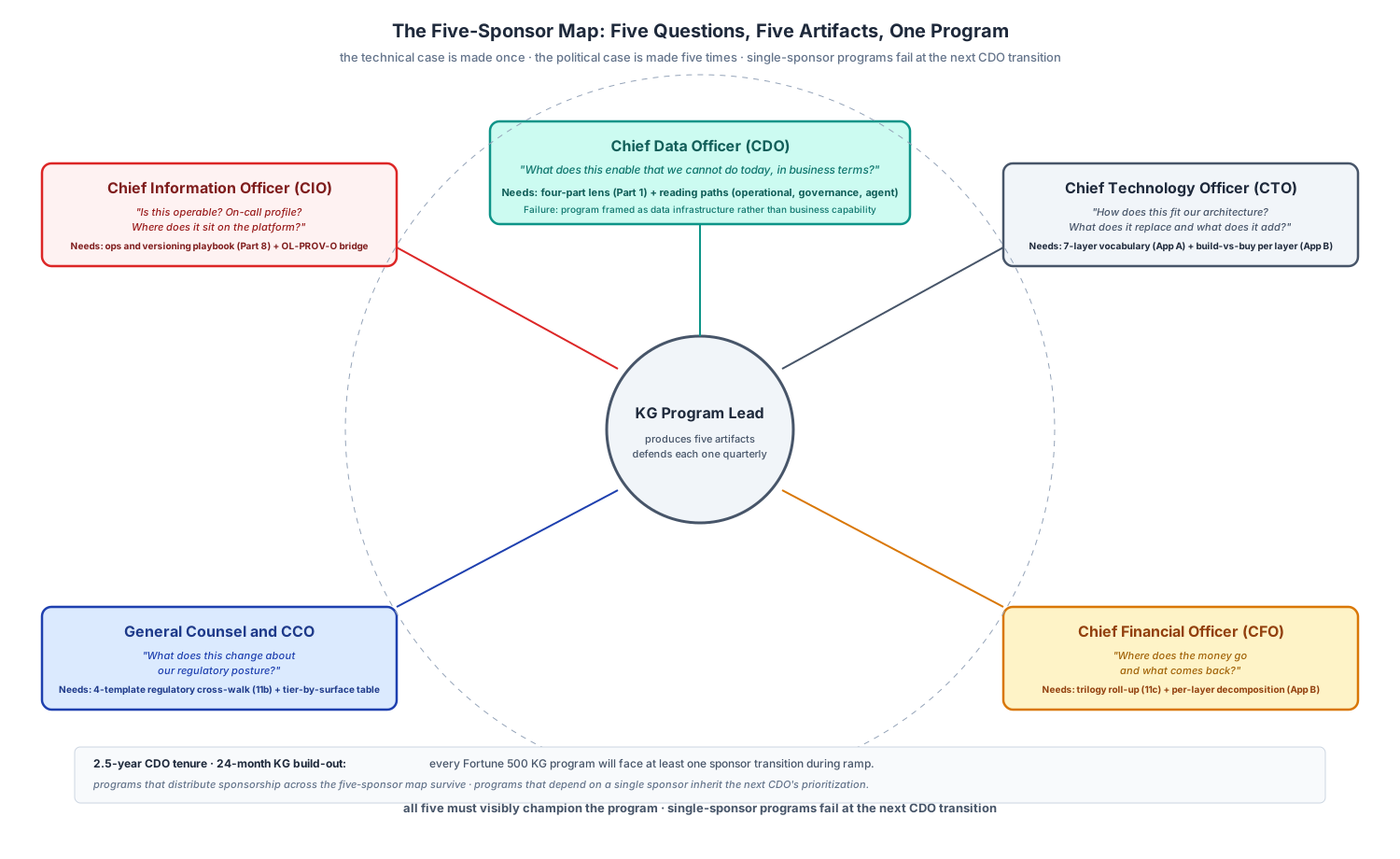
The technical case for a KG is made once. The political case is made five times, once to each of the five executives whose sign-off the program needs to clear procurement, get past the architecture review board, defend the budget at FP&A, satisfy the regulator’s expectations, and survive infrastructure operability reviews. Each of the five asks a different question and needs a different artifact.
| Sponsor | The question they ask | The artifact that answers it | Failure mode if neglected |
|---|---|---|---|
| Chief Data Officer (CDO) | “What does this enable that we cannot do today, in business terms?“ | the four-part lens from Part 1 plus the trilogy reading paths (operational, governance, agent) per the Lakeside capstone | program is framed as data infrastructure rather than as business capability; the next CDO inherits a tool, not a strategy |
| Chief Technology Officer (CTO) | “How does this fit the architecture we already have? What does it replace and what does it add?“ | the seven-layer vocabulary from Appendix A plus the build-versus-buy decision per layer from Appendix B | architecture review board treats the KG as a duplicate of the warehouse; the program does not pass the technology-portfolio review |
| Chief Financial Officer (CFO) | “Where does the money go and what comes back?“ | the trilogy cost-and-benefit roll-up from Part 11c plus the per-layer decomposition from Appendix B plus the eight-question budget diagnostic | program is treated as a science project rather than a business program; year-two budget cycle ends with a flat or reduced run rate |
| General Counsel and Chief Compliance Officer (GC) | “What does this change about our regulatory posture, and is the change defensible?“ | the four-template regulatory cross-walk from Part 11b (BCBS 239, ECB RDARR, GDPR Article 30, EU AI Act Article 10) plus the trust-tier-by-reporting-surface table | regulatory deadlines (EU AI Act Article 10, originally August 2, 2026, now deferred to December 2, 2027 under the 2026 Digital Omnibus) become political ammunition for the warehouse team; the KG is blamed for slowing rather than crediting for accelerating |
| Chief Information Officer (CIO) | “Is this operable? What does the on-call profile look like? Where does it sit on the platform?“ | the operations and versioning playbook from Part 8 plus the trust-tier-survives-operations rule plus the OpenLineage-PROV-O bridge that consumes existing emission rather than re-instrumenting | infrastructure team flags the KG as research-grade tooling; the program does not get production-grade SLAs |
Executive sponsorship across all of business, analytics, and IT visibly championing the program is the well-named requirement of every Data Governance maturity model. The KG-specific specialization is that the five-sponsor map needs five different artifacts produced by the same program, and the program lead is the discipline that keeps all five fresh enough to defend through quarterly reviews. A program that hands the CFO the CDO’s answer and the CIO the CTO’s answer ends with the wrong sponsor reading the wrong artifact, and that is the diagnostic for sponsor-fade (the well-documented failure mode of Data Governance programs).
The Leadership-Transition Survival Discipline
Given the 2.5-year CDO tenure data, the question is not whether a sponsor transition will happen during the KG build-out but how the program survives it. Five practices, distilled from the post-mortems this series has aggregated, are the discipline that distinguishes Pinnacle (which survived its CDO transition with the program intact) from Heartland (which did not).
-
Documented program charter signed by the executive committee, not just the CDO. The charter names the regulatory deadline, the first-year operational use case, the year-two governance commitment, and the year-three agent commitment as commitments of the firm, not of the CDO who proposed them. Single-signature charters do not survive the signature’s departure.
-
Named successor on the executive committee from a non-CDO seat. The CTO, the CFO, or the General Counsel takes a documented role as backup sponsor at the program’s inception. Programs without a backup sponsor land at the next CDO’s discretion; programs with one have a continuity argument that survives the discretion.
-
Embedded business-unit owners with budget skin in the game. Each of the three operational use cases at Lakeside (customer 360, beneficial ownership, transaction risk) had a business-unit owner whose own budget benefited from the use case’s success. BU-budget skin survives executive transitions because the BU’s success metric outlasts the CDO’s tenure. Programs without BU skin land at the next reorganization.
-
A regulatory deadline as a forcing function. The Lakeside governance ramp was anchored to BCBS 239, ECB RDARR, and EU AI Act Article 10 enforcement (originally August 2, 2026, deferred to December 2, 2027 under the 2026 Digital Omnibus). Programs anchored to a regulatory deadline have a defense the next sponsor cannot easily undo without inheriting the regulatory risk. Programs anchored only to internal value face the next sponsor’s prioritization choices.
-
Public quarterly evidence that ties the program to a business metric the next sponsor will inherit. Heartland’s 9-percent risk-adjustment factor recovery improvement was real, but it was not visible at the executive committee level when the new CDO arrived. Programs that surface their evidence in the quarterly pack the executive committee already reads survive the transition; programs that bury their evidence in the data team’s internal review do not.
KEY INSIGHT: every KG program at Fortune 500 scale will outlive its founding CDO. The political question at program inception is not “how do we get the CDO to sign off”; it is “how do we build a program that the next CDO inherits as an asset rather than a problem.” The five-sponsor map plus the five survival practices are the answer. Programs that treat sponsorship as a one-time win at kickoff land at the transition with no defense; programs that treat sponsorship as a quarterly maintenance discipline survive the transition with the program intact.
The pattern I trust most here is not specific to knowledge graphs, and I have watched it sink technically excellent data programs of every kind: the founding sponsor leaves, the new executive inherits a capability they did not choose, and a program with no charter beyond one signature and no visible business metric gets quietly defunded. The lesson I give the people I mentor is blunt. Ship a business owner’s win before you ship the architecture, and put the evidence in the pack the executive committee already reads, or the next CDO will not see why you exist.
Small Wins, Then Trust, Then Scope Expansion: The Political Ramp
The technical ramp from Appendix B’s 24-month team curve has a parallel political ramp that mirrors the discipline of selecting the year-one win for political defensibility, not just for technical impressiveness. The Lakeside discipline, named explicitly:
-
Year one (small wins): pick the operational use case where the BU owner has the largest known pain, the regulator has the closest deadline, and the existing-store owners can claim co-ownership. At Lakeside the pick was customer 360 plus the parallel governance ramp. The pain was the Müller-family three-week reconciliation; the deadline was the BCBS 239 examiner cycle; the co-owners were the catalog admin (catalog-as-reading-pattern), the lineage owner (OL bridge), and the glossary lead (SKOS plus FIBO). The first-year win is the political proof that the program produces value the existing owners want.
-
Year two (trust): ramp the second and third operational BUs, take the governance layer to dedicated headcount, and add the agent layer. By year two the political question is no longer “is this real” but “how far should it go.” The second-year discipline is to stay narrow on scope while widening on depth; year two is when the trust-tier discipline, the version chain, and the SHACL gate quality lock are all earned through production incidents, not through architecture diagrams.
-
Year three (scope expansion): scale to the remaining BUs, expand the agent’s workflow coverage, and integrate the program with the firm’s adjacent governance programs (Model Risk, vendor risk, third-party risk). By year three the program is the firm’s data substrate; the political question becomes which additional functions belong on it. The discipline is to say no to functions that do not require the inference layer the KG provides.
The trap at every stage is to skip the political proof in favor of technical ambition. Programs that try to ship the agent layer in year one before the foundation has earned trust hit the Apex Capital incident from Part 9 at production scale. Programs that try to widen scope in year two before depth has been established hit the boil-the-ocean ontology failure from Part 2. Programs that try to consolidate the governance stores in year one before the BU operational win has shipped hit the Heartland political collapse described above. The order matters; the order is the political ramp.
Six Failure Modes In KG Politics
The patterns below recur across the political post-mortems this series has aggregated. Each is a diagnostic for whether the Heartland trajectory is starting at your firm.
-
Single-sponsor dependency. The CDO is the only executive who can defend the program. When the CDO leaves (within an average of 2.5 years), the program inherits the next CDO’s prioritization. The fix is the five-sponsor map plus the named successor on the executive committee.
-
Science-project framing. The program is described in technical terms (RDF, SPARQL, OWL, SHACL, ontology) without a business-value translation. The CFO reads the program as research; the next budget cycle treats it as discretionary. The fix is the trilogy roll-up artifact, owned by the program lead and refreshed quarterly.
-
Store-consolidation political fight. The program is positioned as replacing the catalog or the lineage tool or the glossary or the policy register. The four owners coordinate their political defense; the program lead spends the year on procurement battles instead of production wins. The fix is the substrate framing: the KG adds a layer the existing tools read from, not a tool that replaces them.
-
Property-graph-only technical reduction. The program is reduced to a property-graph procurement decision. The OWL plus SHACL inference layer that the regulated industry actually needs is dropped from scope; the audit defense that the program would have provided is forfeit. The fix is the regulated-industry question at the start of the Appendix A decision tree, insisted on at every architecture review.
-
Engineering-versus-governance turf war. The platform team and the governance team see each other as obstacle rather than as co-owner. The platform ships a graph store the governance team does not adopt; the governance team writes policies the platform team does not enforce. The fix is the parallel ramp from year one, with the OL-PROV-O bridge as the structural artifact that makes the engineering investment legible to governance and the SHACL gate as the structural artifact that makes the governance investment legible to engineering.
-
The vendor-pitch trap. The procurement runbook lands on a “knowledge graph platform” RFP without an ontologist on staff to evaluate it. The vendor demo passes because the demo dataset has identity already resolved, the SHACL shapes already designed, and the OL emission already configured. The production deployment lacks all three because nobody on the team can produce them. The fix is the layer-level RFP framing from Appendix A’s procurement-trap composite plus the per-layer build-versus-buy decision from Appendix B.
Eight-Question Political Diagnostic
| Question | Defensible answer | Failure mode |
|---|---|---|
| Is your program multi-sponsored across at least three of the five executive seats (CDO, CTO, CFO, GC, CIO)? | Yes; named in the charter, refreshed quarterly | single-sponsor dependency (failure mode 1) |
| Is the value narrative business-stated (banker time recovered, regulator cycle reduced, audit-finding rate dropped) or technology-stated (we built an RDF graph)? | Business-stated; the technology is the substrate, not the value | science-project framing (failure mode 2) |
| Are the existing-store owners co-owners of the new substrate or threat-targets of consolidation? | Co-owners; each owner’s tool becomes more useful on the new substrate | store-consolidation political fight (failure mode 3) |
| Is the build-versus-buy decision per layer (per Appendix B) or per program? | Per layer; 60-percent buy / 40-percent build at year three is the Lakeside ratio | the vendor-pitch trap (failure mode 6) |
| Was the year-one win selected for political defensibility (BU owner pain, regulator deadline, existing-store co-ownership) and not just for technical impressiveness? | Yes; the year-one win has a named BU owner with budget skin in the game | first-year demo without political backing; program collapses at the year-two prioritization review |
| Does the program have a documented charter signed by the executive committee (not just the CDO) that survives the next CDO transition? | Yes; with a named successor sponsor and a regulatory deadline as forcing function | the Heartland trajectory: single-signature charter, no continuity argument |
| Is the governance layer ramping in parallel with the operational layer, anchored to a regulator deadline? | Yes; EU AI Act Article 10 (deferred to December 2, 2027 under the 2026 Digital Omnibus), BCBS 239 cycle, GDPR ROPA cadence | engineering-versus-governance turf war (failure mode 5); year-three governance refactor |
| Are you planning the political ramp (small wins, then trust, then scope expansion) as deliberately as the technical ramp? | Yes; year-one operational + parallel governance, year-two scale-and-depth, year-three scope expansion | technical ambition runs ahead of political proof; year-two collapse |
Tiered Do Next Table
| Priority | Action | Why It Matters |
|---|---|---|
| Now (this quarter) | Map your program to the five-sponsor seats. Identify which seats are filled, which are vacant, and which sponsor has not yet been given the artifact they need. | Single-sponsor dependency is the most common political failure mode at the 2.5-year CDO tenure cadence; the five-sponsor map is the diagnostic |
| Now (this quarter) | Run the eight-question political diagnostic against your current program. Mark each question with a defensible answer or a failure mode. | The diagnostic surfaces year-two political surprises before they arrive; same discipline as the budget diagnostic from Appendix B applied to the political layer |
| Next (next two quarters) | Reframe any “consolidation” language in your program charter to “substrate” language. Identify each existing-store owner and document the co-ownership move that makes their tool more useful on the new substrate. | The substrate framing is the difference between the Heartland collapse and the Pinnacle survival; consolidation framing creates four political opponents, substrate framing creates four political co-owners |
| Next (next two quarters) | Document the program charter; obtain executive-committee signatures (not just the CDO’s); name a successor sponsor from a non-CDO seat; anchor the governance ramp to a regulatory deadline. | The transition-survival discipline is the difference between programs that outlive their founding CDO and programs that do not |
| Soon (next two to four quarters) | Pick or revisit the year-one operational win against the political-defensibility test (BU owner pain + regulator deadline + existing-store co-ownership) and not just the technical-impressiveness test. | First-year wins selected for technical reasons collapse at the year-two prioritization review; first-year wins selected for political reasons earn the trust the year-two scope-and-depth ramp depends on |
| Soon (next two to four quarters) | Build the quarterly evidence pack the executive committee already reads. Surface the program’s business metric at the level the next sponsor will see it. | Evidence buried in the data team’s internal review does not survive the transition; evidence in the EC pack does |
| Eventually (year two and beyond) | Establish the political-ramp discipline (small wins, then trust, then scope expansion) as a documented practice. Resist the technical-ambition pressure to skip a stage. | Programs that skip the political proof in favor of technical ambition hit the failure modes from Parts 2 and 9 at production scale; the order matters |
What Comes Next
Appendix A named the layers, the vendors, and the picks. Appendix B decomposed each layer into the dollar lines and named the team that operates them. Appendix C closed the practical-program guidance with the politics map: the five most common objections and the rebuttal each one earns, the four-or-five-store anti-pattern as a political problem and the substrate framing that resolves it, the five-sponsor map that distributes the political work, the leadership-transition survival discipline anchored to the 2.5-year CDO tenure data, and the small-wins-then-trust-then-scope-expansion political ramp.
Part 12 is the conclusion. Personal-reflection synthesis. What surprised me across the series, what the series got wrong, three gaps the series did not cover, and a full Do Next table spanning all parts. The Overview/Part 0 landing page closes the series with reading paths for the four reader profiles (zero-to-one builder, governance lead, AI/agent architect, executive sponsor) and the full series index. The Lakeside Trust Bank trilogy is the worked example all three appendices refer back to; Part 12 is the personal voice that closes the practitioner’s guide.
Sources & References
- MIT Sloan: Chief data officers don't stay in their roles long. Here's why(2024)
- Harvard Business Review: Why Do Chief Data Officers Have Such Short Tenures?(2021)
- Corporate Compliance Insights: CDO Roles Are Becoming More Popular, But They Often Lack Staying Power(2024)
- Enterprise Knowledge: Why Graph Implementations Fail (Early Signs and Successes)(2024)
- Enterprise Knowledge: Graph Solutions PoC to Production: Overcoming the Barriers(2024)
- Vin Vashishta: Why Most Enterprise Ontologies and Knowledge Graphs Fail (Part 1)(2024)
- ACM Queue: Industry-Scale Knowledge Graphs: Lessons and Challenges(2019)
- First San Francisco Partners: Executive Sponsorship for a Data Governance Program(2024)
- DataGalaxy: Executive Sponsorship and Change Management in Data Governance(2024)
- EWSolutions: Gaining Executive Support for Data Governance(2024)
- CIO: Knowledge Graphs: The Missing Link in Enterprise AI(2025)
- Atlan: Best Collibra Alternatives for Enterprise Data Governance 2026(2026)
- Neo4j: RDF vs. Property Graphs (paradigm clarification)(2024)
- CDO Magazine: CDO Tenure: How to Succeed as a Long-Term Chief Data Officer(2025)
- Forrester Total Economic Impact of Neo4j (vendor-commissioned study, 417% three-year ROI)(2021)
- Graphwise: AstraZeneca: Enabling New Medicines Through Semantic Knowledge Graphs(2024)
Stay in the loop
Get new articles on data governance, AI, and engineering delivered to your inbox.
No spam. Unsubscribe anytime.